
One bad night in flower undoes months
RH spikes at lights-out and the dehu you set by hand never gets turned back up. LoopString texts you before the run rots.
Cultivating non-cannabis (mushrooms, microgreens, lettuce)? See the generic grow rooms page. Evaluating a TrolMaster build? See the comparison.
What actually kills a run
A bad night in flower kills the run
Late flower is unforgiving — an RH spike at lights-out puts water on the buds, and week-8 bud rot ends months of work over a weekend. LoopString catches the spike the night it happens.
Tuned by hand, and you forget to undo it
Clone, veg, flower, dry, and cure each want their own targets, and the dehu you crank at lights-out is easy to forget to turn back up. LoopString holds your night RH target on its own schedule, so the room is not riding on you remembering.
No one sees the slow drift
A grow with several flower rooms plus veg, dry, and cure has no single view, so a room drifts for hours before anyone notices — usually once the quality has already slipped.
The state wants environmental records
METRC and BioTrack track the plants; inspectors increasingly want the environment too, and a paper log is an audit risk. LoopString keeps timestamped records you can export per room.
How LoopString Solves It
VPD held per room, on the Pi
The Pi drives AC, dehumidifier, humidifier, exhaust, and CO₂ for each room, computing VPD on-site so the target follows the canopy — not just the wall thermostat.
Every room on one screen
Veg, every flower room, dry, and cure on one dashboard with sparkline trends. Recipes drive the stage transitions from veg through late flower to dry and cure.
A text before the buds are at risk
Narrow alert windows per room per stage, plus drift detection that catches a failing AC compressor, a stuck dehumidifier, or a CO₂ regulator wandering off — before it reaches the canopy.
Records built for inspection
Every reading logged with a timestamp, and per-room daily, weekly, and full-run PDF reports for inspection, QA, and lot-level traceability.
Built for these cannabis operators
Licensed commercial cultivators
Multi-room flower facilities running METRC / BioTrack / state seed-to-sale; need audit-grade environmental records alongside plant tracking.
Craft + small-batch cultivators
1–3 room operations that want professional-grade automation without integrator-quote pricing.
Sungrown + greenhouse cannabis
Greenhouse cannabis needs supplemental humidity, CO₂, and vent control tuned to outdoor light and temperature swings.
Tissue culture + mother rooms
Clone and mother rooms with tighter T/RH windows and sterile-area procedures need their own controlled environment and records.
Drying + curing rooms
Post-harvest drying (60 °F / 60% RH) → cure (65 °F / 62% RH for weeks) — continuous logging makes terpene preservation defensible.
Multi-location MSOs
Multi-state operators with facilities in different jurisdictions need a single dashboard, RBAC, and state-by-state report exports.
Hardware You'll Use
SHT31
Temperature + humidity per room — feeds the VPD calc
I²CMH-Z19B
CO₂ sensor (1500 ppm target in flower)
UARTDS18B20
Canopy-level temperature probes
1-WireRelay module
Switches AC, dehumidifier, humidifier, exhaust, and the CO₂ valve
GPIO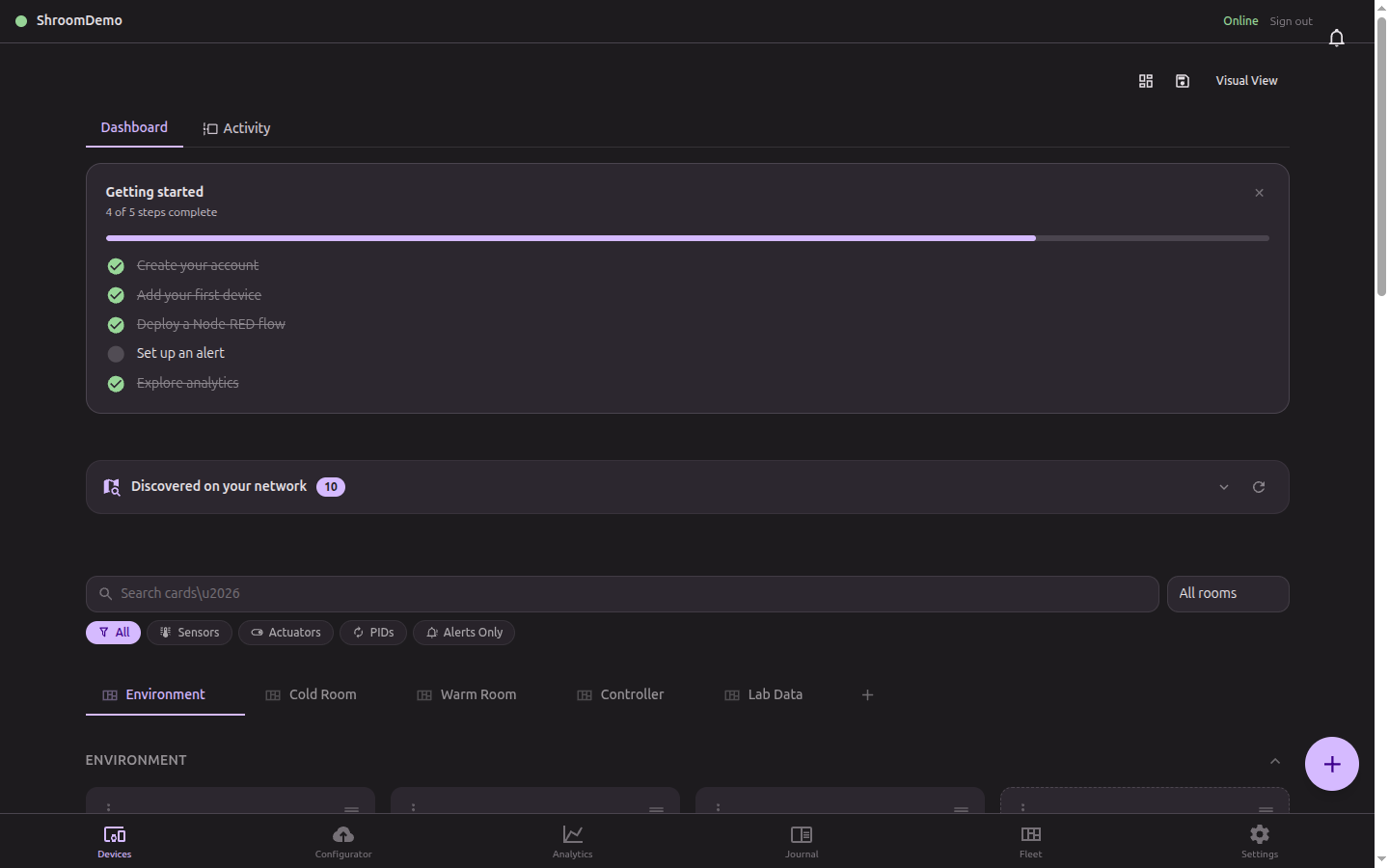
On compliance scope
LoopString provides environmental records (temperature, humidity, CO₂, light, VPD) and automation logs. It does not integrate with METRC, BioTrack, or Confident Cannabis directly — those systems track plant inventory and seed-to-sale. The two layers complement each other: METRC tracks the plant; LoopString tracks the environment the plant grew in. Most state inspectors accept LoopString PDF exports as supporting environmental documentation alongside the METRC trail.
Free tools for this work
Frequently asked questions
- Can LoopString control VPD in a cannabis grow room?
- Yes. It computes VPD from temperature and humidity and drives humidifier, dehumidifier, and fan relays on the Pi to hold your stage-specific VPD target. Targets can differ by veg vs. flower.
- Does LoopString handle CO₂ enrichment safely?
- CO₂ dosing runs with edge safety interlocks on the Pi — enrichment is gated on exhaust/ventilation state and hard ceilings, so the dosing logic stops commanding injection when ventilation is off or a ceiling is reached, without depending on the cloud.
- Can I run separate day and night setpoints and lighting schedules?
- Yes. Schedules switch temperature, humidity, and VPD targets between photoperiod and dark, and can drive lighting/contactor relays. All of it executes on-device on its own clock.
Ready to take the canopy off the wall thermostat?
Start free — no credit card required.