
Dampers, Linear Actuators & Servos: From Hobby Servos to Damper Motors with Feedback — The Complete Quality-Tier Buyer's Guide
By LoopString Team
Quick picks by tier. Hobby → a hobby servo (SG90/MG996R) for light vents and flaps. Maker/Prosumer → a metal-gear servo or a 12 V linear actuator with limit switches. Commercial → a damper/linear actuator with position feedback and spring-return (Belimo-class, 0-10 V / 2-10 V). Hardened industrial / audited → a modulating industrial actuator (Belimo, Siemens) with Modbus, high torque, and fail-safe. Why each wins is below — but if you just need a name, start there.
The thing that actually bites you: position commanded is not position held
A hobby servo will happily move to 90° on the bench and convince you the job is solved. Then you bolt it to a damper that the airflow pushes back on, ask it to hold a partial-open position for hours, and three things go wrong: it lacks the holding torque to stay put under load, it has no feedback you can trust so you never actually know where the blade is, and the continuous modulating duty strips its plastic gears or cooks its tiny motor in days. The servo wasn't lying — it was built for light, intermittent positioning, and you asked it to do proportional control against a load.
The core distinction is open-loop vs closed-loop. An open-loop actuator (most hobby servos, basic linear actuators) goes where you command and you hope it got there; a feedback actuator reports its actual position, so your control loop and your dashboard know the truth — essential when the load can stall it or back-drive it. For HVAC dampers and process valves, position feedback isn't a luxury; it's how you close the loop.
Then there's the requirement nobody specs until it bites: fail-safe behaviour. A damper that must close on power loss (smoke control, freeze protection, safety) needs a spring-return actuator — mechanical energy stored to drive it home with no power. And torque sizing has to cover the load under air or fluid force, plus holding torque, not just free movement.
So the real question isn't "does it move to the angle?" — it's "does it hold position under load, report where it actually is, and fail safe — for a modulating duty cycle?"
The decision axes
- Open-loop vs feedback — command-and-hope vs reports actual position. The defining choice for control.
- Holding torque/force under load — not just running torque; can it stay put when the load pushes back?
- Duty cycle — occasional on/off positioning vs continuous modulating (constant small corrections), which kills hobby gear.
- Fail-safe — spring-return (closes/opens on power loss) for safety and freeze/smoke duty.
- Control signal — PWM (servo) → on/off or analog → 0-10 V / 2-10 V proportional → Modbus, plus a feedback output.
- Stroke/rotation & speed — angle or linear travel, and how fast it must move.
- Environment & rating — temperature, IP rating, and listing for HVAC/process/safety use.
*TierActuatorElementLoopHolding under loadDuty cycleFail-safeControl + feedback*Price (USD)**Best forHobbyHobby servo (SG90, MG996R)Servo (plastic/metal gear)Open-loopPoorIntermittentNonePWM, no feedback$2–10Light vents, flaps, demosProsumerMetal-gear servo / 12 V linear actuatorServo / linear actuatorOpen-loop (+ limits)Holds when stoppedIntermittentNone (limits)PWM / H-bridge + limit sw$20–80Hatches, small dampers, real forceCommercialDamper actuator w/ feedback + spring-return (Belimo)HVAC damper actuatorClosed-loopYesContinuous modulatingSpring-return option0-10 V/2-10 V + feedback$80–400Modulating HVAC dampers, valvesIndustrialModulating industrial actuator (Belimo, Siemens)Modulating + positionerClosed-loopYes (high torque)Continuous modulatingFail-safeModbus / 0-10 V + feedback$300–2000+Large dampers, process valves, BMS
Walking up the ladder
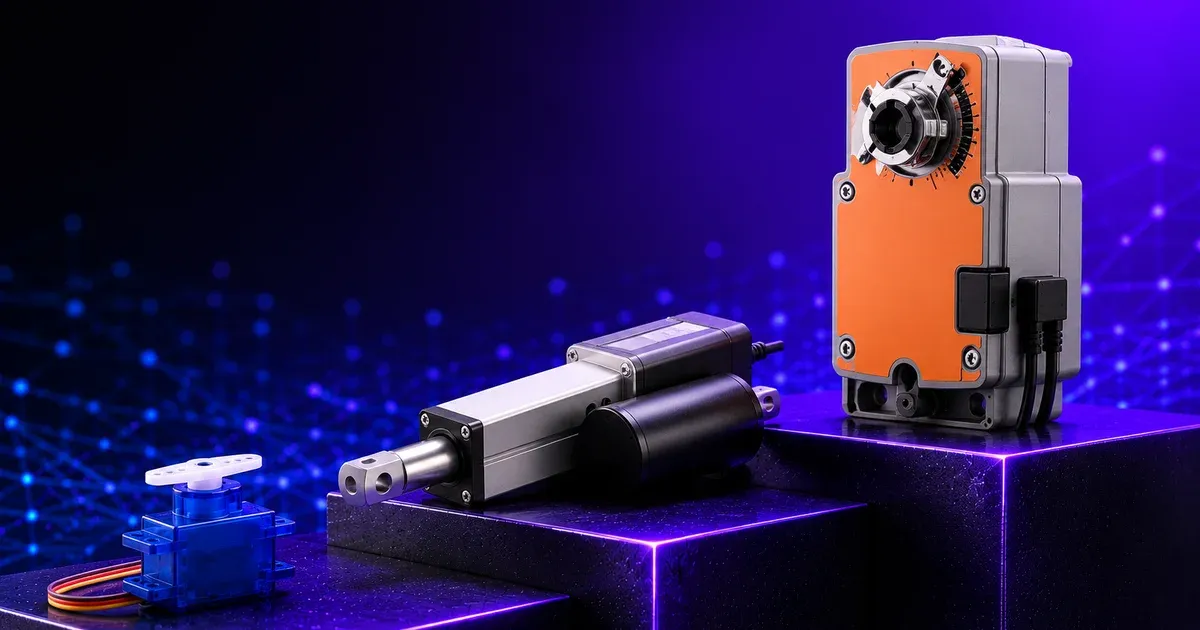
Hobby — hobby servo (SG90, MG996R) ($2–10). Light, fast, positioned by a PWM pulse — ideal for a small vent flap, a demo, or a light louvre that moves now and then. Plastic (or modest metal) gears, little holding torque, no usable feedback, and not built for continuous load. Stop here if the load is light and the moves are occasional.
Maker/Prosumer — metal-gear servo or 12 V linear actuator ($20–80). Real force and stroke: a metal-gear servo holds better, and a 12 V linear actuator with built-in limit switches opens hatches, lifts vents, and moves small dampers, holding position when stopped. Still largely open-loop. Stop here if you need real force and travel for intermittent positioning and can live without proportional feedback.
Commercial — damper/linear actuator with feedback + spring-return ($80–400). Belimo-class HVAC actuators: proportional 0-10 V / 2-10 V control, a position feedback signal so you know the actual blade angle, spring-return fail-safe options, and a duty cycle built for continuous modulation. Stop here if you're modulating HVAC dampers, mixing boxes, or process valves and need to know — and trust — the position.
Hardened industrial — modulating industrial actuator with Modbus ($300–2000+). High-torque modulating actuators and electric valve actuators with positioners (Belimo, Siemens and similar): Modbus/0-10 V control plus feedback, robust fail-safe, IP54+ housings, and the documentation a building-management or process audit expects. You need this tier if you're driving large dampers or process valves with safety, integration, and audit requirements.
Interface & wiring notes (per tier)
- Hobby/metal-gear servo (PWM): a ~50 Hz PWM pulse sets the angle; power the servo from a separate supply (not the Pi's rail) with common ground — stall current will brown out a Pi. Don't ask it to hold a heavy load continuously.
- Linear actuator (DC + limits): drive direction with an H-bridge/relay pair; the built-in limit switches stop it at the ends — read them (and optionally current) to detect stall, since basic units give no position output.
- Proportional actuator (0-10 V / 2-10 V): output the control voltage from a DAC or filtered-PWM buffer on the Pi, and read the feedback voltage back into an ADC so you log actual vs commanded position. Wire the spring-return so power-loss drives the safe state.
- Industrial (Modbus): set position and read actual-position/fault over RS-485; treat a position-mismatch or fault as an actionable alarm.
A note on the angle that lies: without feedback you only know what you commanded, not where the actuator is — a stalled, slipped, or back-driven actuator reports success while the damper sits wrong. For anything modulating or load-bearing, buy position feedback and log actual vs commanded; for anything safety-related, buy spring-return so power loss fails to the safe state.
How LoopString controls every tier — from one dashboard
Here's the part that makes the whole ladder moot from a software standpoint: a Raspberry Pi running LoopString's Node-RED templates drives a $5 servo and an industrial modulating damper actuator from the exact same dashboard — same position control, same schedules, same sensor-driven automation rules, same activity log; and where the actuator provides feedback, the dashboard shows actual position, not just the command. Commands flow from the dashboard through the edge API (over Tailscale) to Node-RED on the Pi, which positions the actuator; the control loop runs on the Pi. You can prototype a vent with a hobby servo and move up to a feedback damper actuator for the real HVAC zone without rewriting your automation. Pick the tier your job actually needs using the table above, wire it to a Pi, and position it from anywhere at app.loopstring.io.
Useful next reads: the greenhouse and grow automation use case, the Raspberry Pi automation guide, and the Raspberry Pi industrial monitoring guide.
Frequently asked questions
Hobby servos are built for light, intermittent positioning, not continuous proportional control against a load. On a damper they lack the holding torque to stay put when airflow pushes back, give no trustworthy position feedback, and the constant small corrections of modulating duty strip their gears or overheat the motor within days. Use a damper actuator rated for modulation with position feedback.