
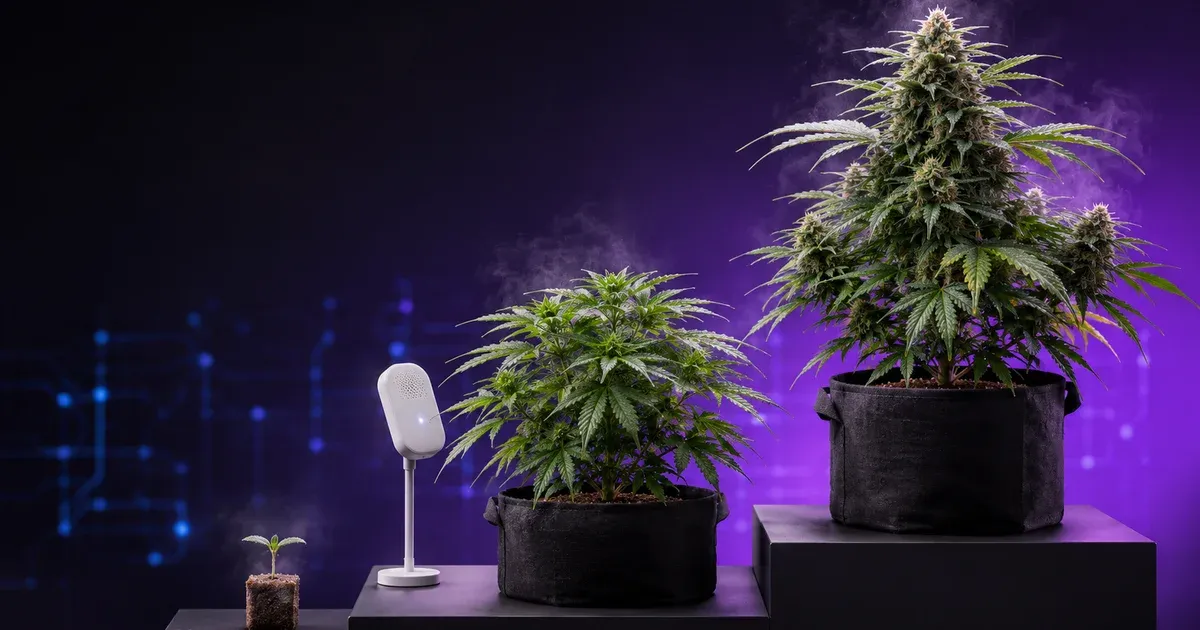
Grow Room VPD by Growth Stage: The Complete Target Chart (2026)
By LoopString
Vapor pressure deficit is the single number that governs how fast a plant transpires, and the right target moves as the plant grows. This is the stage-by-stage reference, why leaf temperature changes it, and how to actually hold it.
The target bands
These are practitioner-consensus leaf-VPD bands (kPa):
[Table content]
Read your exact conditions against the whole grid on the VPD chart, or get the number plus the control action from the VPD calculator.
Why leaf temperature matters
Most VPD advice quietly assumes the leaf is the same temperature as the air. It is not. Under LED or HID light, an actively transpiring leaf runs roughly 2–3°C (3–5°F) cooler than the surrounding air. Because saturation vapor pressure rises steeply with temperature, that small difference moves the real VPD by 0.2–0.4 kPa — enough to push a reading from "in band" to "too dry." Always target leaf VPD, which means applying a leaf-temperature offset to your measurement.
Why RH alone fails
60% RH sounds like a stable target until you check the temperature: it is about 1.2 kPa at 75°F but about 1.6 kPa at 85°F — the first is a healthy veg number, the second is dry enough to stall growth. Set a fixed humidity and your VPD drifts every time the lights heat the room. VPD is the target that already accounts for temperature, which is why it is worth controlling to.
From chart to control
A chart tells you where you are; it cannot hold you there. VPD climbs through the photoperiod and drops at lights-off, so holding it by hand means watching a hygrometer all day. Holding it automatically means a sensor, a per-stage band, and actuators driven to stay inside it — humidifier and dehumidifier, heater and fan — with the target scheduled to ramp as the plant moves from veg to flower. That is exactly what LoopString grow-room automation does with edge PID control on a Raspberry Pi.
Pair this with the PPFD/DLI calculator to match your light to the same stage, and the dew-point calculator to keep condensation off the canopy at night.
Frequently asked questions
Practitioner-consensus leaf-VPD bands are: seedlings and clones 0.4–0.8 kPa, vegetative 0.8–1.2 kPa, early flower 1.0–1.2 kPa, flowering 1.0–1.5 kPa, and late flower or ripening 1.2–1.6 kPa. Younger plants want a smaller deficit (more humid) because their roots and stomata cannot keep up with hard transpiration; mature flowering plants want a larger deficit (drier) to push transpiration and lower mold risk.