
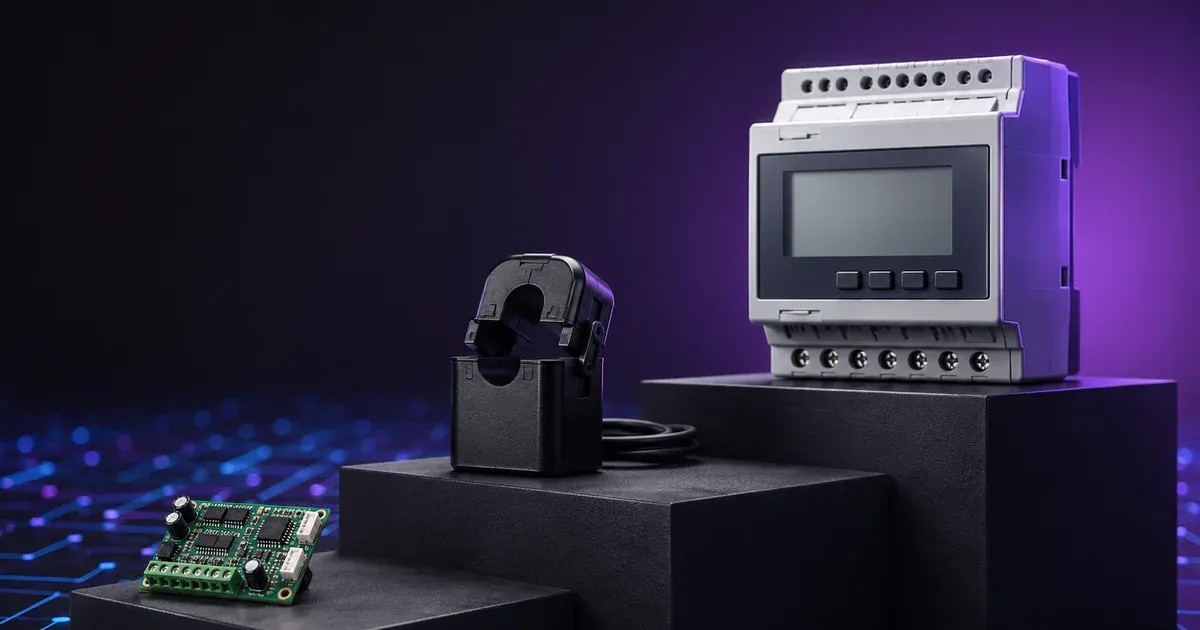
Current & Power Sensors: From CT Clamps to Revenue-Grade Meters — The Complete Quality-Tier Buyer's Guide
By LoopString Team
Quick picks by tier. Hobby (current only) → an SCT-013 split-core CT + burden. Maker (true power) → a CT or shunt into an energy-metering IC (ADE7953 / ATM90E32). Commercial → a DIN-rail Modbus energy meter (Eastron SDM630 or similar, Class 1). Hardened industrial / billing → a metering-class meter (Class 0.5S / MID / ANSI C12.20). Why each wins is below — but read the safety note first.
The thing that actually bites you: current is not power (and an open CT can hurt you)
Two things trip up almost everyone who starts measuring electricity.
First, the conceptual trap: a current clamp measures current, not power. It is extremely tempting to read amps off a CT, multiply by your nominal mains voltage, and call it watts. On a purely resistive load that's roughly right. On anything reactive — motors, pumps, fridges, LED drivers, switching supplies — it overstates real power badly, because it ignores power factor (the phase angle between voltage and current). Apparent power (VA) and real power (W) diverge, and your "energy used" number is fiction. Measuring true power means sampling voltage and current together and integrating — which is exactly what the maker tier and up are built to do.
Second, the safety trap, and this one is physical: never open-circuit the secondary of a current transformer while current flows in the primary. A CT with its burden disconnected under load develops dangerously high voltage across the open terminals — enough to injure you or destroy the sensor. Split-core clamps like the SCT-013 with an internal burden resistor are safe to clip on and off; bare ring CTs are not. Always clamp around a single conductor (around both line and neutral, the fields cancel and you read zero), and treat anything connected to mains as mains.
So the real question isn't "how many amps?" — it's "do I need current or true power, and is this install metering-class enough that someone will bill or audit from it?"
The decision axes
- What it measures — current only (CT/clamp) vs true power (V + I sampled together for W, VA, PF, kWh).
- Accuracy class — hobby CTs are ±1–3%; commercial meters are Class 1 (±1%); revenue/metering meters are Class 0.5S / 0.2S and MID- or ANSI-C12.20-certified.
- Invasiveness — non-invasive split-core clamp (no rewiring) vs solid-core CT or in-line shunt (must break the circuit).
- Phases — single-phase vs three-phase (and whether you need per-phase data).
- Interface — analog (CT into an ADC) → pulse output (kWh) → RS-485 Modbus → metering protocols.
- Certification — MID / ANSI C12.20 for anything you'll bill or sub-bill from — the audit/legal requirement.
- Safety rating — internal-burden split-core (safe to handle) vs bare CT; insulation and CAT rating for the install location.
Tier | Device | Element | Measures | Accuracy class | Phases | Interface | Price (USD) | Best for |
|---|---|---|---|---|---|---|---|---|
Hobby | SCT-013 split-core CT | CT (internal burden) | Current only (RMS A) | ±1–3% | 1-phase | Analog (ADC) | $10–15 | Non-invasive "is it running" |
Prosumer | CT/shunt + energy IC (ADE7953 / ATM90E32) | Energy-metering IC | True power, PF, kWh | ~±1% | 1- or 3-phase | SPI / I²C | $20–60 | Circuit sub-monitoring, real kWh |
Commercial | DIN Modbus meter (Eastron SDM630) | Metering chip + CTs | True power, PF, kWh, per-phase | Class 1 (±1%) | 3-phase | RS-485 Modbus | $50–300 | Buildings, lines, tenant circuits |
Industrial | Metering-class meter (MID / ANSI C12.20) | Revenue meter | True power + billing kWh | Class 0.5S / 0.2S | 3-phase | Modbus / pulse / metering | $300–1500+ | Billing, custody, regulated reports |
Walking up the ladder
Hobby — SCT-013 split-core CT ($10–15). Clip-on, non-invasive, no rewiring, internal burden so it's safe to handle. Read the AC waveform through an ADC and you get RMS current, ±1–3%. It's current only — estimate power by assuming a voltage and you accept power-factor error. Stop here if you want to see "is the pump running and roughly how hard" without touching the wiring.
Maker/Prosumer — CT/shunt + energy-metering IC ($20–60). Feed a CT (and a voltage reference) into a dedicated energy IC — ADE7953 (single-phase) or ATM90E32 (three-phase) — and you get genuine real power, apparent power, power factor, and accumulated kWh, computed in hardware. This is the smallest jump that turns "amps" into trustworthy energy data. Stop here if you're sub-monitoring circuits, a workshop, or appliances and want real kWh you can act on.
Commercial — DIN-rail Modbus energy meter ($50–300). A purpose-built meter (Eastron SDM630, Schneider iEM, Accuenergy) wired in on the DIN rail with its own CTs, Class 1 accuracy, full three-phase metrics, and RS-485 Modbus out. Robust, sealed, and trivial to multi-drop across a panel. Stop here if you're monitoring a building, a production line, or tenant circuits and need solid per-phase energy without legal billing.
Hardened industrial / billing — metering-class meter ($300–1500+). Class 0.5S or 0.2S accuracy, MID-certified (EU) or ANSI C12.20 (US), traceable, sealed against tampering — the grade you must use to bill a customer, run custody-transfer, or feed a regulated sustainability report. You need this tier if money or a regulator depends on the kWh number.
Interface & wiring notes (per tier)
- SCT-013 CT (analog): clamp one conductor only; the internal burden makes it safe, but read it through an ADC (the Pi has no analog input) with a bias network to centre the AC waveform. Sample fast enough to compute true RMS.
- Energy-metering ICs (ADE7953 / ATM90E32): SPI/I²C to the Pi; they need a calibrated voltage divider on the mains reference — this is a live-mains connection, so isolate it properly (a metering IC breakout with onboard isolation, or a transformer-based voltage sense).
- Modbus DIN meters: A/B differential pair + ground, 120 Ω termination, multi-drop up to 32 nodes; read over a USB-RS485 or HAT. The meter does all the metrology; the Pi just polls registers.
- CT safety, restated: never disconnect a CT's burden while primary current flows; size CTs to the breaker rating; respect the panel's CAT rating and have a qualified electrician make any in-panel connection.
How LoopString reads every tier — in one dashboard
A Raspberry Pi running LoopString's Node-RED templates reads a $12 SCT-013 through an ADC and a $200 SDM630 over Modbus into the same dashboard — same live power trend, same over-current and runtime alerts, same kWh history and duty-cycle stats. Prototype circuit monitoring with a clip-on CT, then drop in a Class 1 Modbus meter for the permanent install without rebuilding your dashboards or alerts. Wire your meter to a Pi and see it live at app.loopstring.io.
Useful next reads: the Raspberry Pi industrial monitoring guide, the Raspberry Pi automation guide, and the MQTT sensor dashboard overview.
Frequently asked questions
A current clamp measures current, not power. On a purely resistive load, amps × voltage is roughly right, but on anything reactive — motors, pumps, fridges, LED drivers, switching supplies — it overstates real power badly because it ignores power factor (the phase angle between voltage and current). Apparent power (VA) and real power (W) diverge, so the "energy used" number becomes fiction. Measuring true power means sampling voltage and current together and integrating, which the maker tier and up (energy-metering ICs, Modbus meters) do in hardware.
Related posts
- Dosing & Circulation Pumps: From Hobby Peristaltic to Industrial Metering Pumps — The Complete Quality-Tier Buyer's Guide
- Solenoid Valves: From Plastic Direct-Acting to Stainless Process Valves — The Complete Quality-Tier Buyer's Guide
- Fans & Blowers: From PWM PC Fans to Industrial EC Blowers — The Complete Quality-Tier Buyer's Guide