
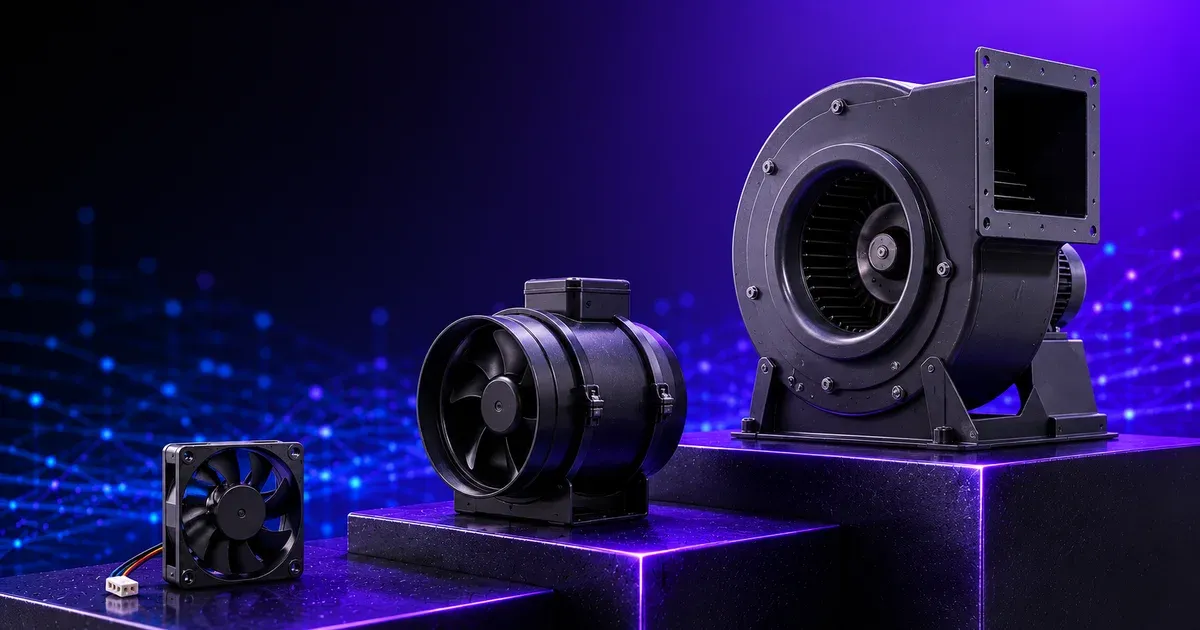
Fans & Blowers: From PWM PC Fans to Industrial EC Blowers — The Complete Quality-Tier Buyer's Guide
By LoopString Team
Quick picks by tier. Hobby → a 12 V 4-pin PWM PC fan (with tach). Maker/Prosumer → a quality PWM fan (Noctua) or a 12/24 V EC axial with ball/maglev bearings. Commercial → an EC inline or centrifugal fan with 0-10 V control and tach feedback. Hardened industrial / audited → an industrial blower / ECM with Modbus, sealed bearings, and high static pressure. Why each wins is below — but if you just need a name, start there.
The thing that actually bites you: CFM is a free-air lie
The number on the fan box — "120 CFM!" — is measured in free air, with nothing in front of the fan. Your real system has a filter, ducting, a carbon scrubber, bends, and a grille, all of which fight the fan with static pressure. Push an axial fan against static pressure and its airflow collapses fast; that 120 CFM fan might move 40 through your filter. Blowers and centrifugal fans are built to hold airflow against pressure; axial fans aren't. The only honest way to size a fan is its fan curve (airflow vs static pressure) at your system's resistance — not the headline CFM. This is the single most common ventilation mistake, and it's why grow tents with carbon filters never seem to move enough air.
The second killer is bearing life in heat and humidity. Cheap fans use sleeve bearings that dry out and seize fast in the hot, humid air a fan often lives in — exactly the conditions in an enclosure or grow room. Ball, fluid-dynamic, or maglev bearings (and EC motors generally) last years where a sleeve bearing lasts months. A fan that fails is worse than no fan because you sized your cooling around it.
Third: how you control it, and whether it tells you it stalled. PWM (4-pin DC) and 0-10 V (EC) give smooth speed control; a tach output lets you detect a stalled or dying fan before the thing it was cooling overheats. And EC (electronically commutated) motors are the real efficiency story — far more CFM-per-watt, soft-start, and clean speed control versus shaded-pole AC fans.
So the real question isn't "how many CFM?" — it's "how much air at my static pressure, for my duty hours, in my heat and humidity — and will I know if it stalls?"
The decision axes
- Airflow at static pressure (the fan curve) — not free-air CFM. Axial collapses against pressure; centrifugal/blower holds.
- Axial vs centrifugal/blower — high flow at low pressure vs lower flow at high pressure (filters, ducts).
- Bearing type & lifespan — sleeve (short life in heat/humidity) vs ball / FDB / maglev / EC.
- Motor type & efficiency — shaded-pole AC vs brushless DC vs EC (best CFM-per-watt and control).
- Control signal — fixed → PWM (DC) → 0-10 V (EC) → Modbus; and tach/feedback for stall detection.
- Duty & environment — continuous duty, temperature, humidity, dust; IP rating for harsh service.
- Noise — matters for occupied spaces; EC and quality bearings win.
*TierFanTypeStatic pressureMotorBearing lifeControl + feedback***Price (USD)**Best forHobby12 V 4-pin PWM PC fanAxialLowDCSleeve (short in heat)PWM + tach$3–15Enclosure cooling, open-space airflowProsumerQuality PWM (Noctua) / 12-24 V EC axialAxialLow–moderateDC / ECBall/FDB/maglev (years)PWM / 0-10 V + tach$15–50Closets, small grows, cabinetsCommercialEC inline / centrifugal (0-10 V)Centrifugal / inlineHighEC (high CFM/W)Long, sealed0-10 V + tach/alarm$80–400Carbon-filter/duct ventilation, grow roomsIndustrialIndustrial blower / ECM (Modbus)Blower / centrifugalVery highECMSealed, IP-ratedModbus + feedback$300–2000+Fume extraction, process ventilation
Walking up the ladder
Hobby — 12 V 4-pin PWM PC fan ($3–15). Cheap, instantly controllable from a Pi, with a tach wire for RPM feedback — great for cooling an enclosure or a 3D printer. Low static pressure (it won't push through a filter) and sleeve-bearing versions die early in heat. Stop here if you're moving air across an open space or cooling electronics and nothing critical rides on it.
Maker/Prosumer — quality PWM fan (Noctua) or 12/24 V EC axial ($15–50). Ball or fluid-dynamic bearings for real lifespan, better static-pressure variants, low noise, and a dependable tach. An EC axial adds efficiency and smooth control. Stop here if you want reliable, controllable airflow for a closet, a small grow, or a cabinet that runs continuously.
Commercial — EC inline / centrifugal fan with 0-10 V control ($80–400). Now you're buying air at pressure: an EC inline or centrifugal fan holds CFM through filters and ducting, runs efficiently (high CFM-per-watt), soft-starts, and takes a 0-10 V speed signal with tach/alarm feedback. The grow-room and light-commercial HVAC standard. Stop here if you're ventilating through a carbon filter or ducting, or running a grow room or small facility.
Hardened industrial — industrial blower / ECM with Modbus ($300–2000+). High static pressure, sealed bearings, IP-rated, continuous-duty, with Modbus control and feedback for fume extraction, process ventilation, and ducted systems. You need this tier if you're moving air against serious pressure, in dust or fumes, around the clock, with integration and diagnostics.
Interface & wiring notes (per tier)
- 4-pin PWM fan (DC): drive the PWM control wire at ~25 kHz (audible-range PWM whines) and read the open-collector tach with a GPIO + pull-up for RPM/stall detection. The PWM pin controls speed; don't try to speed-control by chopping the power rail.
- EC fan (0-10 V): generate 0-10 V from the Pi via a small DAC or filtered-PWM buffer; read the fault/tach output. EC fans soft-start, so inrush is gentle.
- AC fan / blower: switch via a relay/contactor (and remember an AC induction fan isn't smoothly speed-controllable without a proper VFD/EC motor — don't just triac-dim it).
- Industrial (Modbus): set speed and read status/alarms over RS-485; treat a stall or fault flag as an actionable alert tied to whatever the fan protects.
A note on the CFM that lies: always size by the fan curve at your system's static pressure, not the box number. Add the resistance of filters (especially loaded carbon filters), ducting, and bends, pick axial vs centrifugal accordingly, and choose bearings/motor for the heat, humidity, and duty hours — a stalled or undersized fan fails the thing it was cooling.
How LoopString controls every tier — from one dashboard
Here's the part that makes the whole ladder moot from a software standpoint: a Raspberry Pi running LoopString's Node-RED templates drives a $5 PWM fan and an industrial EC blower from the exact same dashboard — same speed control, same schedules, same temperature/humidity-driven automation rules, same tach/stall alerts and duty-cycle log. Commands flow from the dashboard through the edge API (over Tailscale) to Node-RED on the Pi, which sets fan speed; the control loop runs on the Pi. You can prototype enclosure cooling with a PC fan and move up to an EC inline fan for the grow room without rewriting your automation. Pick the tier your airflow actually needs using the table above, wire it to a Pi, and tune it from anywhere at app.loopstring.io.
Useful next reads: the greenhouse and grow automation use case, the Raspberry Pi automation guide, and the Raspberry Pi industrial monitoring guide.
Frequently asked questions
Because CFM is rated in free air, with nothing in front of the fan. Your filter, ducting, bends, and grille add static pressure, and axial fans lose airflow rapidly against it — a loaded carbon filter is especially brutal. Size by the fan's curve (airflow vs static pressure) at your system's resistance, and use a centrifugal fan or blower when there's real back-pressure.
Related posts
- Dosing & Circulation Pumps: From Hobby Peristaltic to Industrial Metering Pumps — The Complete Quality-Tier Buyer's Guide
- Solenoid Valves: From Plastic Direct-Acting to Stainless Process Valves — The Complete Quality-Tier Buyer's Guide
- Dissolved Oxygen Sensors: From Galvanic Probes to Optical RDO — The Complete Quality-Tier Buyer's Guide