
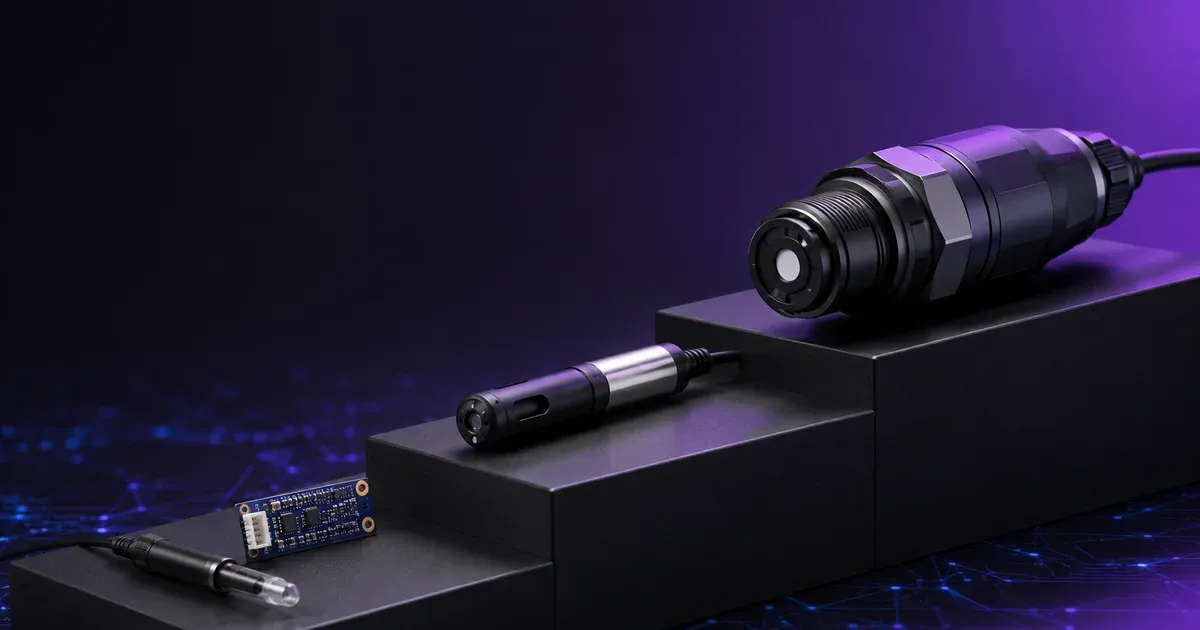
Dissolved Oxygen Sensors: From Galvanic Probes to Optical RDO — The Complete Quality-Tier Buyer's Guide
By LoopString Team
Quick picks by tier. Hobby → an analog galvanic membrane probe on a Gravity/DFRobot board. Maker/Prosumer → Atlas Scientific EZO-DO (galvanic, digital, isolated). Commercial → an optical/luminescent DO sensor (RDO/LDO) on Modbus or SDI-12. Hardened industrial / audited → a process optical DO instrument (Hach LDO, Endress+Hauser Oxymax) with traceable calibration. Why each wins is below — but if you just need a name, start there.
The thing that actually bites you: membranes are maintenance, not measurement
The number a dissolved oxygen probe reads is the easy part. The hard part is that the cheapest way to measure DO — a membrane galvanic or polarographic cell — consumes oxygen to work. It needs water moving across the membrane to keep reading true, the electrolyte ages, and the membrane fouls and tears. The practical consequence is a probe that's dead-accurate the day you calibrate it and quietly drifting low two weeks later, with a recalibration and a membrane/electrolyte refill standing between you and a trustworthy reading.
The upgrade that actually matters isn't a tighter accuracy spec — it's a different physics. Optical (luminescent) DO sensors measure the lifetime of a light-excited dye that oxygen quenches. They don't consume oxygen, don't depend on flow across a membrane, and hold calibration for months instead of weeks. That single change is the difference between a sensor you babysit and one you bury in a pond and forget.
And whichever you pick, a raw DO reading is incomplete: true mg/L depends on temperature, salinity, and barometric pressure. A sensor that doesn't compensate for all three will read confidently wrong in brackish or high-altitude water.
So the real question isn't "what's the mg/L?" — it's "will this number still be true in a month without me changing a membrane and recalibrating, in my water?"
The decision axes
- Sensing principle — galvanic/polarographic membrane (consumes O₂, flow-dependent, high maintenance) vs optical/luminescent (no consumption, no flow dependence, low maintenance).
- Accuracy & resolution — typically ±0.1–0.5 mg/L; the spread between tiers is smaller than the maintenance spread.
- Calibration cadence — weekly for cheap galvanic, monthly-to-quarterly for optical, scheduled-with-certificate for industrial.
- Compensation — temperature is table stakes; salinity and barometric/altitude compensation separate real instruments from hobby boards.
- Flow dependence — galvanic needs sample flow/stirring; optical does not.
- Interface & enclosure — analog board → digital I²C/UART → 4-20 mA / Modbus / SDI-12 IP68 process probe.
- Consumables & lifespan — membrane caps, electrolyte, and optical sensor caps (the dye photobleaches and is replaced on a schedule).
- Traceable calibration — the audit requirement; only process instruments ship a certificate.
Tier | Sensor | Principle | Accuracy | Calibration cadence | Maintenance | Interface | Price (USD) | Best for |
|---|---|---|---|---|---|---|---|---|
Hobby | Analog galvanic probe + Gravity/DFRobot board | Galvanic membrane (consumes O₂) | ±0.2–0.5 mg/L | weekly | membrane + electrolyte | Analog (ADC) | $60–170 | Aquariums, hobby aquaponics |
Prosumer | Atlas Scientific EZO-DO | Galvanic, digital + isolated | ±0.05 mg/L | weekly–monthly | membrane caps | I²C / UART | $200–300 | Small aquaculture, records |
Commercial | Optical RDO/LDO sensor | Optical/luminescent (no consumption) | ±0.1 mg/L or ±1–2% | monthly–quarterly | sensor cap (periodic) | 4-20 mA / Modbus / SDI-12 | $400–1200 | Ponds, RAS, wastewater |
Industrial | Process optical DO (Hach LDO, E+H Oxymax) | Optical + auto-clean, traceable | ±0.1 mg/L | scheduled w/ certificate | hot-swap cal cap | 4-20 mA / Modbus | $1000–3000+ | Municipal, GxP, audited |
Walking up the ladder
Hobby — analog galvanic probe + Gravity/DFRobot board ($60–170). A membrane galvanic cell read as a millivolt signal. Genuinely useful for a hobby aquarium, a backyard aquaponics loop, or learning the chemistry. Expect single-point or two-point calibration, manual temperature entry, and a membrane/electrolyte service every few weeks. Stop here if nothing you sell or defend depends on the exact number.
Maker/Prosumer — Atlas Scientific EZO-DO ($200–300 with probe). The same galvanic chemistry, but with a digital, electrically isolated front end (I²C/UART), proper temperature and salinity/pressure compensation registers, and a far cleaner calibration workflow. ±0.05 mg/L when fresh. Stop here if you run a small aquaculture tank, a serious aquaponics system, or a brewery and keep informal records — and you don't mind membrane upkeep.
Commercial — optical/luminescent DO (RDO/LDO) on Modbus or SDI-12 ($400–1200). This is the tier where you stop fighting the membrane. No oxygen consumption, no flow dependence, drift measured per year not per week, an IP-rated body you can submerge in a pond or a sump, and 4-20 mA / Modbus / SDI-12 output for long, noisy runs. Stop here if you have outdoor ponds, RAS aquaculture, wastewater, or any multi-point deployment where weekly probe service isn't viable.
Hardened industrial — process optical DO with traceable cal ($1000–3000+). Hach LDO, Endress+Hauser Oxymax, Insite and similar: optical sensing with auto-cleaning options, hot-swappable pre-calibrated sensor caps, redundant compensation, long warranties, and traceable calibration certificates that satisfy municipal, environmental, and GxP auditors. You need this tier if a regulator or customer will ask to see the cal cert.
Interface & wiring notes (per tier)
- Analog galvanic board: a millivolt/ADC signal — keep leads short and shielded, and feed it a real temperature reading for compensation. Let the probe polarize/warm up before trusting it.
- EZO-DO (I²C / UART): use the isolated carrier board — DO probes share water with pH/EC probes and ground loops between them wreck readings. Write temperature, salinity, and pressure before reading.
- Optical Modbus / SDI-12 probe: RS-485 A/B pair or SDI-12 bus, multi-drop several sensors on one run; needs a USB-RS485 or SDI-12 interface on the Pi. The optical cap is the consumable — replace it on the manufacturer's schedule, not when it fails.
- Process 4-20 mA instrument: loop-powered and immune to voltage drop over long runs; read through an ADC or 4-20 mA HAT. Auto-clean (air-blast/wiper) options keep biofouling off the optic in dirty water.
A note on the readings that lie: a DO probe in still water reads low because it has locally depleted the oxygen at the membrane — galvanic probes especially need movement. And a probe calibrated in air-saturated water but deployed without salinity compensation will overstate DO in brackish or saline water. Calibrate the way the manufacturer specifies, and compensate for all three of temperature, salinity, and pressure.
How LoopString reads every tier — in one dashboard
Here's the part that makes the whole ladder moot from a software standpoint: a Raspberry Pi running LoopString's Node-RED templates reads a $120 galvanic probe and a $1500 process optical instrument into the exact same dashboard — same live telemetry, same low-DO threshold alerts, same compliance log. You can prototype an aeration control loop on an EZO-DO and swap in an optical Modbus probe for production without touching your dashboards, alerts, or history. Pick the tier your water actually needs using the table above, wire it to a Pi, and see it live in minutes at app.loopstring.io.
Useful next reads: the greenhouse and grow monitoring use case, the Raspberry Pi automation guide, and the MQTT sensor dashboard overview.
Frequently asked questions
For anything beyond a hobby tank, optical (luminescent/RDO/LDO). Galvanic and polarographic membrane sensors consume oxygen, depend on flow across the membrane, and need frequent membrane and electrolyte service plus recalibration. Optical sensors don't consume oxygen, work without flow, and hold calibration for months — the lower maintenance is worth more than any datasheet accuracy difference.
Related posts
- Dosing & Circulation Pumps: From Hobby Peristaltic to Industrial Metering Pumps — The Complete Quality-Tier Buyer's Guide
- Solenoid Valves: From Plastic Direct-Acting to Stainless Process Valves — The Complete Quality-Tier Buyer's Guide
- Fans & Blowers: From PWM PC Fans to Industrial EC Blowers — The Complete Quality-Tier Buyer's Guide