
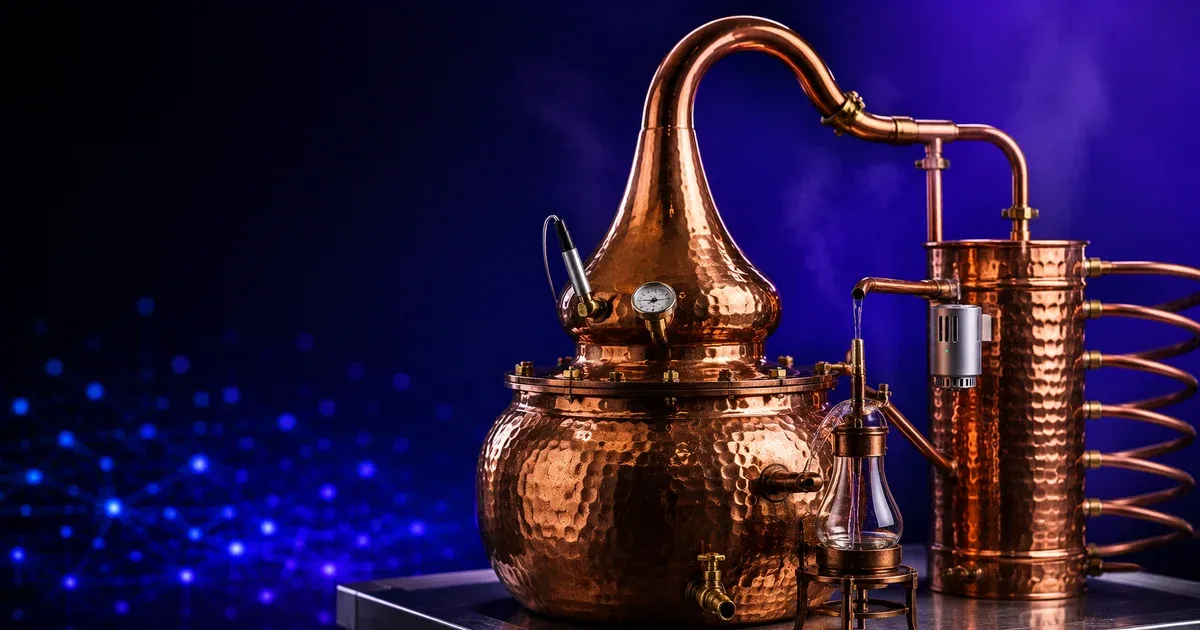
Distillery Still-Run Monitoring: Temperatures, Cut Points & Safety (2026)
By LoopString
During a still run, monitor three things continuously: the vapor (still-head) temperature, the condenser coolant temperature/flow, and the spirit output — because together they tell you where you are in the run, when to make your cuts, and whether the process is safe. Distilling is both a precision-temperature craft and a genuinely hazardous one (flammable high-proof vapor, toxic methanol in the early fraction), so good instrumentation is part of running a still well. Here's what to watch and why.
This is process-monitoring guidance, not a how-to-distill guide. Distilling alcohol is heavily regulated — in the US a federal distilled-spirits permit (TTB) is required — and involves fire and toxicity hazards. Operate legally and safely.
What to monitor
- Vapor / still-head temperature: the key process signal. As the wash heats, lower-boiling-point compounds come over first; the head temperature climbs through the run as the remaining liquid's alcohol content falls. Watching this curve is how distillers track the run and anticipate the cuts.
- Pot / boiler temperature: confirms heating rate and helps you avoid scorching the wash; for steam/electric, it's the input you modulate.
- Condenser coolant: inlet/outlet temperature and ideally flow. If coolant fails, hot ethanol vapor escapes the condenser uncondensed — a fire hazard — so this is a safety-critical loop, not just an efficiency one.
- Spirit output: flow/temperature at the parrot, paired with the distiller's hydrometer/ABV reading, to mark the cuts.
Temperature and the cuts
A spirit run is separated into fractions, and temperature is one of the main guides (alongside ABV, smell, and taste):
- Foreshots: the very first vapor — lowest boiling point, contains methanol and acetone. Discarded. Never to be drunk.
- Heads: harsh, solventy volatiles next over the temperature climb — cut away or redistilled.
- Hearts: the clean ethanol fraction you keep — collected through the middle of the run while the head temperature is in the target window.
- Tails: as the head temperature climbs further, heavier fusel oils and water come over, getting oily and weak — cut and saved for the next run's redistillation.
The exact temperatures depend on the still geometry, pressure, and wash, so distillers rely on the curve and the trend plus sensory cues rather than a single magic number — which is precisely why a continuous, logged temperature trace is so valuable.
Why continuous logging and alerts matter
Two reasons — quality and safety.
Quality/repeatability: a logged head-temperature-vs-time curve for every run lets you make cuts at the same points batch after batch and reproduce a spirit you liked. Run-to-run consistency is hard to achieve from manual thermometer glances; it's easy from a recorded curve.
Safety: the dangerous failures — coolant loss, over-pressure, or runaway boiler heat — are exactly the kind of slow-then-sudden events that a threshold alert catches early. An alert when condenser outlet temperature climbs (coolant failing) or boiler temperature runs away gives you time to cut the heat before vapor escapes uncondensed.
Monitoring a still with LoopString
The LoopString platform fits a still room directly: thermocouple or RTD probes (the catalog supports K-type via MAX31855 and PT100/RTD) read vapor, boiler, and condenser temperatures continuously; the dashboard plots the live head-temperature curve so you can see the run develop and mark cuts against a repeatable trace; and threshold alerts fire on the safety-critical conditions — condenser coolant warming, boiler overheating — reaching you remotely. Every run logs to history for batch records and TTB documentation. For an electric or steam still it can also modulate the heating element/valve to hold a controlled ramp. You get a repeatable, documented, alarmed still run instead of a thermometer and a guess.
Quick reference
- Monitor vapor/head temp, boiler temp, and condenser coolant continuously — plus spirit output for the cuts.
- Use the head-temperature curve and trend (with ABV/smell/taste) to guide foreshots → heads → hearts → tails.
- Always discard foreshots — methanol comes over first.
- Treat condenser coolant as safety-critical: alert on rising outlet temperature.
- Log every run for repeatable cuts and compliance records.
Frequently asked questions
The key signal is the vapor or still-head temperature, which climbs through the run as lower-boiling compounds come over first and the remaining alcohol content falls. Distillers also watch the boiler/pot temperature and the condenser coolant temperature, and pair the head-temperature curve with ABV, smell, and taste to make cuts.