
Gas & VOC Sensors: From MQ Modules to Fixed Gas Detectors — The Complete Quality-Tier Buyer's Guide
By LoopString Team
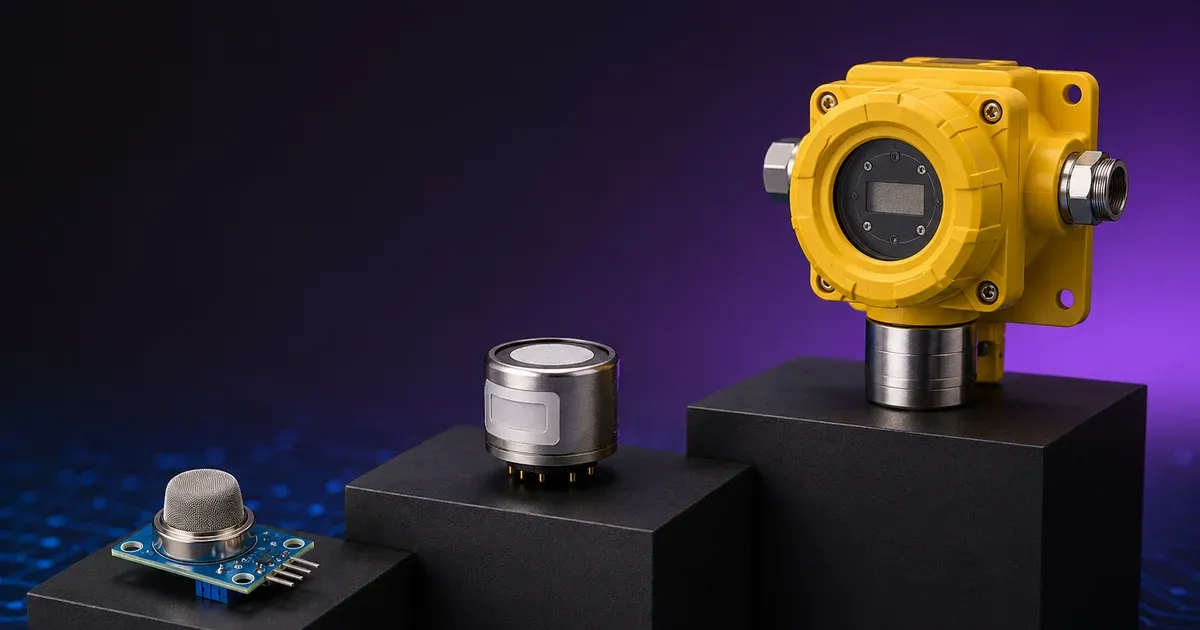
Quick picks by tier. Hobby (trend only) → an MQ-series metal-oxide module. Maker/Prosumer → an electrochemical cell for a specific gas (CO, H₂S, O₂, NH₃). Commercial → a catalytic-bead %LEL or NDIR hydrocarbon sensor. Hardened industrial / life-safety → a certified fixed gas detector (intrinsically safe, ATEX/IECEx). Why each wins is below — but read the safety line first, because this is the one category where the wrong choice can kill someone.
The safety line: a hobby gas sensor is not a life-safety device
Every other sensor in this series is about data quality. Gas detection is about people. So before tiers: a Raspberry Pi with an MQ-series module is not a substitute for a certified, alarmed gas detector. If a leak could asphyxiate, poison, or ignite — carbon monoxide in an occupied space, combustible gas near an ignition source, H₂S, refrigerant in a plant room — you must use a device that is certified for that gas, alarmed (audible/visible, fail-safe), and maintained (bump-tested and calibrated on a schedule). Use the hobby and maker tiers for monitoring, automation, and trends; use the industrial tier for anything where a life depends on it. Treat them as complementary, never as alternatives.
The thing that actually bites you: poisoning, drift, and silent end-of-life
Gas sensors are chemistry, and chemistry ages — in three ways that quietly fool people.
- MOX poisoning & cross-sensitivity. Cheap metal-oxide sensors (the MQ family) respond to many gases at once and can't tell them apart — an "MQ-135 air quality" reading is a qualitative blob, not a calibrated ppm of any one gas. Worse, they're poisoned by silicones (off-gassing from sealants, adhesives, cosmetics) and degraded by long high-concentration exposure, after which they under-report — the dangerous failure direction.
- Electrochemical cells expire on a clock. A specific-gas electrochemical cell is genuinely quantitative, but it's a wet-chemistry consumable with a finite life (often 1–3 years) that ticks down even unused as the electrolyte dries. An expired cell can read low or zero while looking healthy.
- Catalytic beads get poisoned and need oxygen. Pellistor %LEL sensors for combustibles are poisoned by silicones and leaded compounds, and they physically cannot detect a flammable mixture in a low-oxygen atmosphere — a known, deadly limitation that NDIR hydrocarbon sensors avoid.
The through-line: gas sensors fail toward under-reporting, and they fail silently. That's exactly why the upper tiers exist — they add certification, fail-safe alarms, and mandatory bump testing (a quick exposure to test gas to prove the sensor and alarm still respond).
So the real question isn't "what's the ppm?" — it's "is this a calibrated reading of a specific gas, will it still respond when it matters, and does a life depend on it?"
The decision axes
- Selectivity — broadband qualitative (MOX) vs gas-specific quantitative (electrochemical, NDIR).
- What it detects — toxic (CO, H₂S, NH₃), oxygen deficiency, combustibles (%LEL), or CO₂/hydrocarbons (NDIR).
- Poisoning & lifespan — MOX poisoned by silicones; electrochemical cells expire on a timer; catalytic beads poisoned and O₂-dependent.
- Quantitative accuracy — arbitrary index → ±5% of a specific gas → certified metrology.
- Certification — the life-safety requirement: intrinsically safe, ATEX/IECEx for hazardous areas, plus alarm and bump-test provisions.
- Interface — analog/I²C module → 4-20 mA → Modbus + alarm relays.
Tier | Sensor | Type | Selectivity | Quantitative | Lifespan / poisoning | Interface | Price (USD) | Best for |
|---|---|---|---|---|---|---|---|---|
Hobby | MQ-series MOX | Metal-oxide | Broadband (many gases) | Qualitative index | Poisoned by silicones | Analog | $3–8 | Relative trend — NOT life safety |
Prosumer | Electrochemical cell | Electrochemical | Gas-specific (CO/H₂S/O₂/NH₃) | ppm ±5% | 1–3 yr consumable | Analog / I²C | $30–80 | Specific-gas monitoring |
Commercial | Catalytic bead (%LEL) / NDIR | Pellistor / NDIR | Combustibles / hydrocarbon-CO₂ | %LEL / ppm | Bead poisoned + needs O₂; NDIR robust | 4-20 mA / Modbus | $50–300 | Combustible / flammable detection |
Industrial | Certified fixed gas detector | Certified (IS, ATEX/IECEx) | Gas-specific, certified | ppm / %LEL ±5% | Scheduled bump/cal | 4-20 mA + relays | $500–3000+ | Life-safety, hazardous areas, audited |
Walking up the ladder
Hobby — MQ-series metal-oxide ($3–8). MQ-2, MQ-7, MQ-135 and friends: cheap, broadband, qualitative. Great for learning, for relative "is there more smoke/gas/VOC than a minute ago" automation, and for triggering a fan. They cannot quantify a specific gas and they're poisoned by silicones. Stop here if you want relative trend or experimentation — never life safety.
Maker/Prosumer — electrochemical cell ($30–80). A cell tuned to one gas — CO, H₂S, O₂, NH₃, Cl₂ — giving a genuine, calibrated ppm at ±5%, often on an I²C or analog module (e.g. Alphasense, SPEC, Sensirion). Quantitative and specific, but a consumable: plan to replace the cell every 1–2 years. Stop here if you need a real ppm of a known gas for monitoring or process control (paired with a certified detector if life-safety applies).
Commercial — catalytic bead (%LEL) or NDIR hydrocarbon ($50–300). For combustibles: a pellistor reads percent of the Lower Explosive Limit, the standard for flammable-gas monitoring — but watch poisoning and the oxygen requirement. NDIR hydrocarbon/CO₂ sensors detect by infrared absorption, immune to poisoning and able to read in low-oxygen atmospheres. 4-20 mA or Modbus. Stop here if you're monitoring combustibles or CO₂ in a fixed installation that isn't the primary life-safety alarm.
Hardened industrial / life-safety — certified fixed gas detector ($500–3000+). Intrinsically safe, ATEX/IECEx-rated transmitters with fail-safe alarm relays, 4-20 mA, traceable calibration, and documented bump-test/calibration cycles — the only tier you may rely on where a leak threatens life or where a hazardous-area classification applies. You need this tier if people, ignition risk, or a regulator are in the picture.
Interface & wiring notes (per tier)
- MQ MOX (analog): needs a heater warm-up (minutes to hours for stable baseline) and an ADC; the output is a resistance ratio, not ppm. Keep away from silicone sealants that will poison it.
- Electrochemical (analog / I²C): low-noise, well-referenced front end; respect the cell's temperature/humidity range and log the install date so you replace it before expiry. Zero/calibrate with known gas.
- Catalytic bead / NDIR (4-20 mA / Modbus): loop-powered transmitters for long runs; for catalytic beads ensure adequate oxygen and avoid poisoning exposure; NDIR is the robust choice for dirty or low-O₂ environments.
- Certified fixed detector (4-20 mA + relays / Modbus): wire the fail-safe alarm relays to the actual mitigation (alarm, ventilation, shutoff); maintain the documented bump-test and calibration schedule — the certification is only valid if you keep it tested.
How LoopString reads every tier — in one dashboard
A Raspberry Pi running LoopString's Node-RED templates reads an MQ module over an ADC, an electrochemical CO cell over I²C, and a certified 4-20 mA detector into the same dashboard — same live trend, same threshold automation (trip a fan, open a damper, send an alert), same history for your records. LoopString is the monitoring and automation layer on top of properly rated detectors — it logs and acts on them; it does not replace a certified alarm. Wire your sensors to a Pi and see them live at app.loopstring.io.
Useful next reads: the Raspberry Pi industrial monitoring guide, the Raspberry Pi automation guide, and the MQTT sensor dashboard overview.
Frequently asked questions
No. A Pi with an MQ-series module is a monitoring and trend tool, not a life-safety device. If a leak could asphyxiate, poison, or ignite — CO in an occupied space, combustible gas near ignition, H₂S, refrigerant in a plant room — you need a certified, alarmed, maintained detector (intrinsically safe, ATEX/IECEx, bump-tested on a schedule). Treat the hobby and maker tiers as complementary to a certified alarm, never as a substitute.
Related posts
- Dosing & Circulation Pumps: From Hobby Peristaltic to Industrial Metering Pumps — The Complete Quality-Tier Buyer's Guide
- Solenoid Valves: From Plastic Direct-Acting to Stainless Process Valves — The Complete Quality-Tier Buyer's Guide
- Fans & Blowers: From PWM PC Fans to Industrial EC Blowers — The Complete Quality-Tier Buyer's Guide