
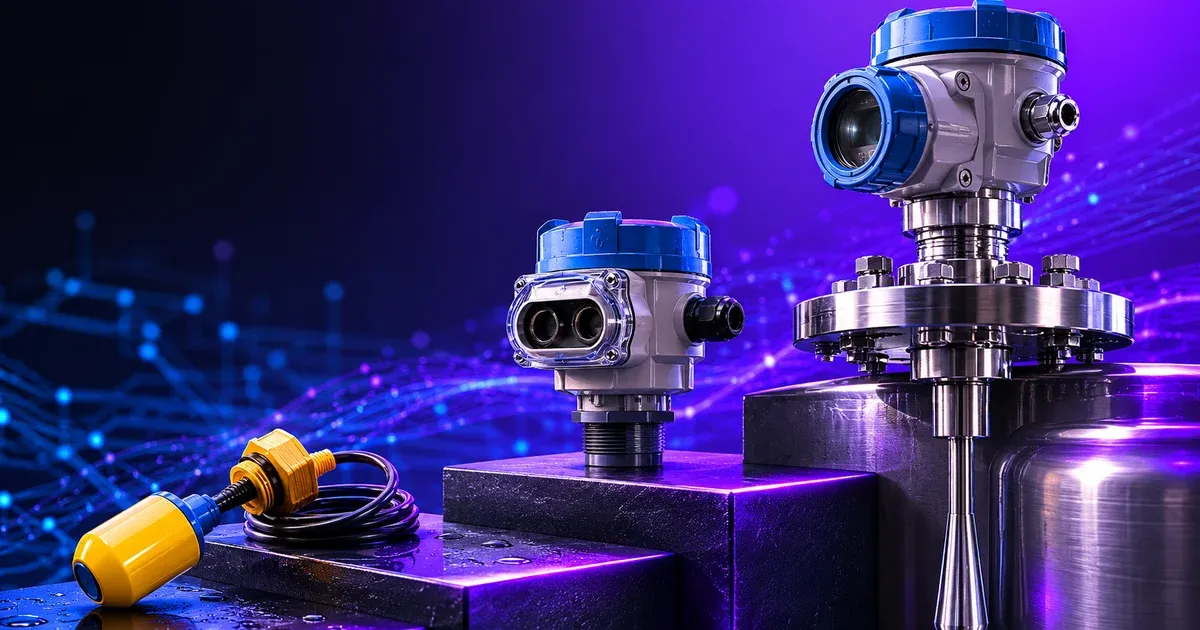
Level Sensors: From Float Switches to Guided-Wave Radar — The Complete Quality-Tier Buyer's Guide
By LoopString Team
Quick picks by tier. Hobby → a reed float switch (point) or an HC-SR04 ultrasonic / submersible pressure sensor (continuous). Maker/Prosumer → an industrial ultrasonic level transmitter or a hydrostatic submersible probe. Commercial → guided-wave (TDR) or non-contact radar. Hardened industrial / audited → a process radar (Rosemount, VEGA, Endress+Hauser) with traceable calibration and SIL rating. Why each wins is below — but if you just need a name, start there.
The thing that actually bites you: real tanks have foam, vapor, dust, and coating
Level sensing looks trivial on a clean tank of clear water and gets hard the instant you put real product in it. The cheap technologies fail on exactly the things production tanks have: ultrasonic needs a clear line of sight to a flat liquid surface, so foam absorbs the echo, vapor and condensation scatter it, and an agitator or a domed top confuses it. Capacitance drifts when the medium's dielectric changes or sticky product coats the probe. Floats stick, hang up on buildup, and only tell you one point. The sensor that read perfectly on the test bench reads nonsense on the silo.
The first fork is also the one people skip: point vs continuous. A float switch answers "is it above this height?" (pump-on/pump-off, high-level alarm) for a few dollars. A transmitter answers "what percent full is it?" continuously — a different, more expensive job. Buying continuous when you only needed a high-level switch wastes money; buying a switch when you needed a trend wastes the deployment.
So the real question isn't "how full is the tank?" — it's "will this technology survive the foam, vapor, dust, agitation, and coating my actual product creates — and do I need a point alarm or a continuous level?"
The decision axes
- Point vs continuous — a switch (one threshold) vs a transmitter (continuous level/volume). Decide this first.
- Technology vs media — float, ultrasonic, hydrostatic/submersible pressure, capacitance, guided-wave radar (TDR), non-contact radar. Each has media it loves and media it fails on.
- Foam / vapor / dust / agitation tolerance — the real-world disqualifiers; radar (especially guided-wave) tolerates most, ultrasonic the least.
- Coating / buildup — sticky or crystallizing product fouls contacting probes; non-contact radar or hydrostatic wins.
- Contact vs non-contact — hygienic, corrosive, or high-temperature media may forbid a probe in the product.
- Interface & enclosure — GPIO/analog → 4-20 mA → Modbus/HART, with IP/NEMA and (for fuels/solvents) hazardous-area rating.
- Accuracy & range — dead zones near the sensor, minimum/maximum measuring distance, and whether you need volume (tank-shape linearization) or just level.
- Traceable calibration / SIL — the audit and functional-safety requirement for custody or overfill protection.
Tier | Sensor | Technology | Point / Continuous | Foam/vapor/dust tolerance | Contact? | Interface | Price (USD) | Best for |
|---|---|---|---|---|---|---|---|---|
Hobby | Reed float switch | Float | Point | n/a (mechanical, sticks) | Contact | GPIO (dry contact) | $2–10 | Pump on/off, hi/lo alarm |
Hobby | HC-SR04 ultrasonic / submersible pressure | Ultrasonic / hydrostatic | Continuous | Poor (US) / good (submersible) | Non-contact / contact | GPIO / analog | $5–30 | Clean still water, hobby tanks |
Prosumer | Industrial ultrasonic / hydrostatic transmitter | Ultrasonic / hydrostatic | Continuous | Moderate | Non-contact / contact | 4-20 mA | $80–400 | Water tanks, sumps, lift stations |
Commercial | Guided-wave (TDR) / non-contact radar | Radar | Continuous | Excellent | GW contact / radar non-contact | 4-20 mA / Modbus / HART | $300–1500 | Foam, vapor, dust, coating, chemicals |
Industrial | Process radar (Rosemount, VEGA, E+H) | Radar + volume linearization | Continuous | Excellent | Non-contact / probe | 4-20 mA / HART / Modbus, SIL | $1000–5000+ | Custody, overfill safety, audited |
Walking up the ladder
Hobby — reed float switch, or HC-SR04 / submersible pressure ($3–30). A float switch is a rugged, dead-simple point level for pump control or a high/low alarm. For continuous level on the cheap, an HC-SR04 ultrasonic (non-contact distance) or a small submersible pressure sensor (hydrostatic head) both work — on clean water, in a calm tank. Stop here if it's a rain barrel, a sump, or a hobby reservoir and the liquid is clean and still.
Maker/Prosumer — industrial ultrasonic transmitter or hydrostatic submersible ($80–400). IP-rated, temperature-compensated, 4-20 mA output, proper dead-zone and range specs. Ultrasonic stays non-contact (good for mildly dirty water); a submersible pressure probe ignores foam and vapor entirely because it reads from the bottom. Stop here if you have outdoor water tanks, sumps, or lift stations without heavy foam or aggressive chemistry.
Commercial — guided-wave (TDR) or non-contact radar ($300–1500). This is the tier that stops fighting the tank. Guided-wave radar runs a microwave pulse down a probe and is largely immune to foam, vapor, dust, and changing dielectric; non-contact radar does the same without touching the product, ideal for sticky or corrosive media and solids in silos. 4-20 mA / Modbus / HART. Stop here if you have foam, vapor, dust, agitation, coating, or chemicals — i.e. a real process tank or silo.
Hardened industrial — process radar with traceable cal / SIL ($1000–5000+). Rosemount, VEGA, Endress+Hauser: high-accuracy radar with tank-shape volume linearization, hazardous-area certification, SIL-rated overfill protection, and traceable calibration for custody transfer and audited inventory. You need this tier if the measurement is billed against, protects against overfill as a safety function, or faces an auditor.
Interface & wiring notes (per tier)
- Float switch (GPIO): a dry contact into a GPIO with a pull-up; debounce in software so sloshing doesn't chatter the pump. Mount where buildup won't hang the float.
- HC-SR04 / ultrasonic (GPIO/serial): mind the dead zone right below the sensor and keep the beam clear of tank walls, ladders, and the inlet stream; it needs a flat, foam-free surface.
- Submersible pressure (4-20 mA / analog): reads hydrostatic head, so calibrate to the liquid's density; vent the reference tube to atmosphere (gauge pressure) or barometric changes look like level changes.
- Radar (4-20 mA / Modbus / HART): set the empty/full reference distances and the dielectric/medium profile; guided-wave needs the probe clear of agitators and heavy turbulence. Read 4-20 mA via an ADC/HAT or Modbus via RS-485.
A note on the bench-vs-tank gap: test on the actual product, not clean water. Foam, vapor, surface turbulence, condensation on the sensor face, and probe coating all show up only with the real medium. If your product foams or coats, skip ultrasonic/capacitance and budget for radar — it's cheaper than a season of bad readings.
How LoopString reads every tier — in one dashboard
Here's the part that makes the whole ladder moot from a software standpoint: a Raspberry Pi running LoopString's Node-RED templates reads a $5 float switch and a process radar transmitter into the exact same dashboard — same live level, same high/low threshold alerts, same history. You can prototype tank monitoring with ultrasonic and move up to guided-wave radar when the foam beats it, without touching your dashboards or alert rules. Pick the tier your tank actually needs using the table above, wire it to a Pi, and watch the level live at app.loopstring.io.
Useful next reads: the Raspberry Pi industrial monitoring guide, the Raspberry Pi automation guide, and the MQTT sensor dashboard overview.
Frequently asked questions
Ultrasonic needs a clear line of sight to a flat liquid surface. Foam absorbs the echo, vapor and condensation scatter it, agitation breaks the surface, and the beam can catch tank walls, ladders, or the inlet stream. There's also a dead zone right below the sensor. If your tank has any of those, move to a submersible pressure probe (reads from the bottom) or guided-wave radar.
Related posts
- Dosing & Circulation Pumps: From Hobby Peristaltic to Industrial Metering Pumps — The Complete Quality-Tier Buyer's Guide
- Solenoid Valves: From Plastic Direct-Acting to Stainless Process Valves — The Complete Quality-Tier Buyer's Guide
- Fans & Blowers: From PWM PC Fans to Industrial EC Blowers — The Complete Quality-Tier Buyer's Guide