
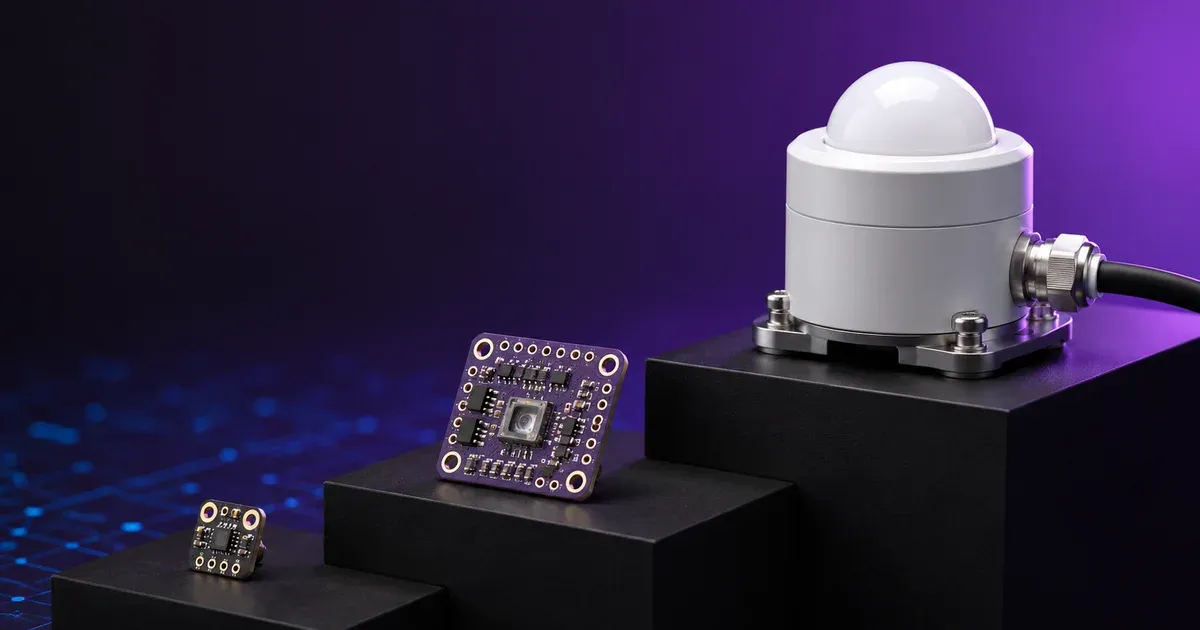
Light & PAR Sensors: From BH1750 to Spectroradiometers — The Complete Quality-Tier Buyer's Guide
By LoopString Team
Quick picks by tier. Hobby (ambient light) → BH1750 or TSL2591 (lux). Maker (rough spectral/PAR) → an AS7341 multi-channel spectral sensor. Commercial (real grow light) → an Apogee SQ-500 quantum PAR sensor. Hardened industrial / research → a spectroradiometer. Why each wins is below — but read the next section first, because the cheap sensors measure the wrong thing for plants.
The thing that actually bites you: lux is not PPFD
The single most common mistake in horticultural lighting is buying a lux sensor to measure plant light. Lux is weighted to the human eye — the photopic curve that peaks in green and barely counts the deep red and blue that plants live on. A grow light heavy in red can pump out enormous photosynthetic energy and read modest in lux; a green-rich light reads bright to a lux meter and does little for a canopy. Lux tells you how a room looks to a person. It does not tell you what a plant receives.
What plants care about is PPFD — photosynthetic photon flux density — the count of photons in the 400–700 nm photosynthetically-active range hitting a surface each second, in µmol/m²/s. That's a photon count, not a brightness, and you can't convert lux to PPFD reliably because the conversion factor depends entirely on the light's spectrum. A cheap lux chip simply cannot produce a trustworthy PPFD number for an unknown spectrum.
There's a newer wrinkle worth knowing: ePAR (extended PAR, 400–750 nm) includes far-red, which research shows also drives photosynthesis via the Emerson effect. Some modern quantum sensors measure ePAR; standard PAR sensors stop at 700 nm.
So the real question isn't "how many lux?" — it's "am I measuring brightness for people, or photon flux for plants, and does my sensor's spectral response actually match the job?"
The decision axes
- Quantity measured — lux (photopic, for humans) vs PPFD/PAR (µmol/m²/s, for plants) vs full spectral power distribution.
- Spectral response — how closely the sensor's sensitivity curve matches the ideal (photopic for lux, flat 400–700 nm for PAR). Cheap PAR sensors have a wobbly response that adds error under narrow-band LEDs.
- Calibration — raw counts → lux → factory PPFD calibration → traceable spectral calibration.
- Cosine correction — a proper quantum sensor has a diffuser so off-angle light is weighted correctly; a bare chip over-counts head-on light.
- Range & saturation — full sun is ~2000 µmol/m²/s; indoor sensors saturate, outdoor/grow sensors don't.
- Interface — I²C lux chip → analog/SDI-12 quantum sensor → USB/SDI-12 spectroradiometer.
Tier | Sensor | Measures | Spectral response | Accuracy | Cosine corrected | Interface | Price (USD) | Best for |
|---|---|---|---|---|---|---|---|---|
Hobby | BH1750 / TSL2591 | Lux (photopic) | Human-eye weighted | — | No | I²C | $2–8 | Ambient light, on/off — NOT plant light |
Prosumer | AS7341 spectral | 11-channel spectral | Visible bands | Approx PPFD | No | I²C | $15–30 | Rough PPFD, spectrum shape |
Commercial | Apogee SQ-500 quantum | PPFD µmol/m²/s | Flat 400–700 nm (ePAR opt) | ±5% | Yes | Analog / SDI-12 | $250–400 | Grow rooms, greenhouses, real PAR |
Industrial | Spectroradiometer | Full SPD µmol/m²/s/nm | Full spectrum, traceable | <±5% | Yes | USB / SDI-12 | $1500–5000+ | Research, fixture characterization |
Walking up the ladder
Hobby — BH1750 / TSL2591 (lux) ($2–8). Tiny I²C lux sensors, fine for what they are: ambient-light awareness, day/night detection, automatic display dimming, "is the grow light on?" They are photopic — do not use them to set or compare plant light levels beyond the crudest sanity check. Stop here if you only need human-perceived brightness or on/off light detection.
Maker/Prosumer — AS7341 spectral sensor ($15–30). An 11-channel spectral sensor that splits visible light into bands, so you can approximate PAR and see the rough shape of your spectrum — a big step up from a single lux number for hobby growers tuning LEDs. It's still not a calibrated quantum sensor, but it knows colour. Stop here if you're a serious hobby grower who wants spectral insight without instrument prices.
Commercial — Apogee SQ-500 quantum PAR sensor ($250–400). This is the real grower's instrument: a cosine-corrected, factory-calibrated quantum sensor reading true PPFD in µmol/m²/s, ±5%, with a flat 400–700 nm response (ePAR variants available). Analog or SDI-12 out for permanent canopy monitoring. Stop here if you run a commercial grow, greenhouse, or research bench and need defensible PPFD.
Hardened industrial / research — spectroradiometer ($1500–5000+). Measures the full spectral power distribution — µmol/m²/s per nanometre — so you get PPFD, ePAR, lux, CCT, and the exact spectrum from one traceable instrument. Used to characterise fixtures, validate research, and satisfy audits. You need this tier if you're publishing data, characterising luminaires, or meeting a regulated spec.
Interface & wiring notes (per tier)
- BH1750 / TSL2591 (I²C): SDA/SCL + pull-ups; watch for saturation under bright light (set the integration time/gain) and for I²C address clashes with other breakouts.
- AS7341 (I²C): multi-channel readout; use a diffuser and consistent geometry, because tilt and distance change the band ratios.
- Quantum PAR sensor (analog / SDI-12): the analog versions output a tiny millivolt signal — read through a precision, low-offset ADC and keep the cable away from noise; SDI-12 versions digitise at the sensor for long runs. Mount at canopy height, level, with the diffuser clean.
- Spectroradiometer (USB / SDI-12): instrument-grade; follow its calibration interval and keep the cosine diffuser spotless — dust skews the short wavelengths first.
How LoopString reads every tier — in one dashboard
A Raspberry Pi running LoopString's Node-RED templates reads a $5 BH1750 over I²C and a $350 Apogee quantum sensor over SDI-12 into the same dashboard — same live light trend, same daily-light-integral (DLI) rollups, same alerts when a fixture drifts or fails. Prototype with a lux chip, then add a calibrated PAR sensor for the canopy that actually matters, without rebuilding anything. Wire your sensor to a Pi and see it live at app.loopstring.io.
Useful next reads: the greenhouse monitoring use case, the Raspberry Pi automation guide, and the MQTT sensor dashboard overview.
Frequently asked questions
Lux is weighted to the human eye — the photopic curve peaks in green and barely counts the deep red and blue that plants live on. A red-heavy grow light can pump out enormous photosynthetic energy yet read modest in lux, while a green-rich light looks bright to a lux meter and does little for a canopy. Plants care about PPFD (photosynthetic photon flux density, a photon count in µmol/m²/s over 400–700 nm), and you can't reliably convert lux to PPFD because the factor depends entirely on the light's spectrum.
Related posts
- Dosing & Circulation Pumps: From Hobby Peristaltic to Industrial Metering Pumps — The Complete Quality-Tier Buyer's Guide
- Solenoid Valves: From Plastic Direct-Acting to Stainless Process Valves — The Complete Quality-Tier Buyer's Guide
- Fans & Blowers: From PWM PC Fans to Industrial EC Blowers — The Complete Quality-Tier Buyer's Guide