
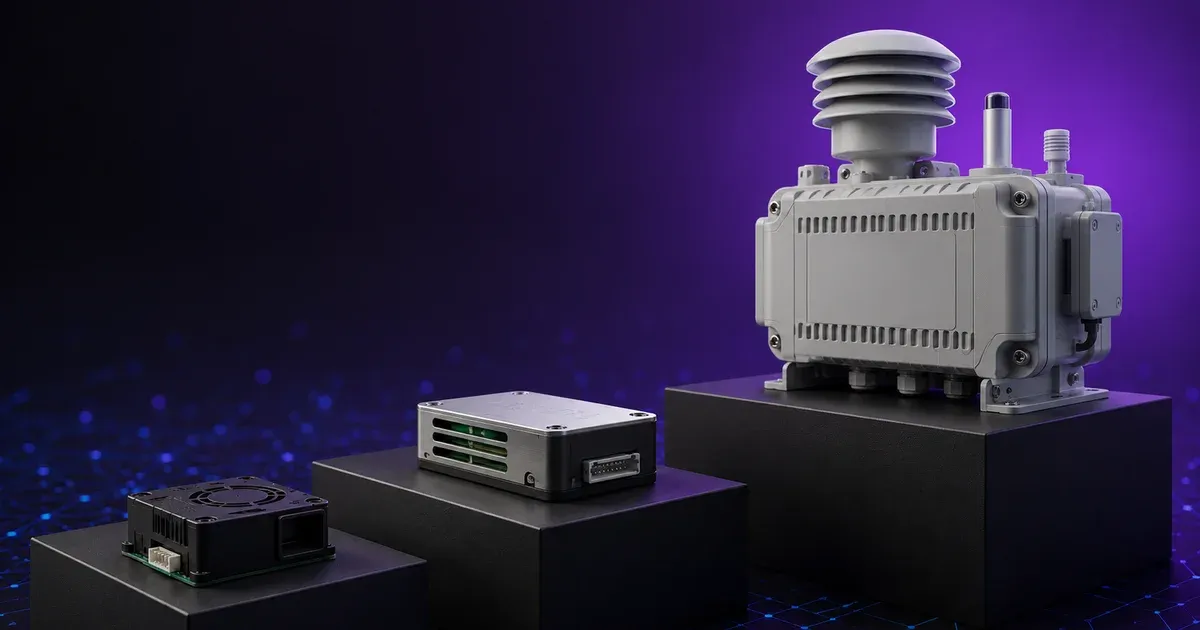
Particulate Matter (PM2.5/PM10) Sensors: From PMS5003 to Reference Monitors — The Complete Quality-Tier Buyer's Guide
By LoopString Team
Quick picks by tier. Hobby → a Plantower PMS5003. Maker/Prosumer → a Sensirion SPS30. Commercial → an IP-rated optical PM probe on Modbus. Hardened industrial / regulatory → a beta-attenuation monitor (BAM) or TEOM. Why each wins is below.
The thing that actually bites you: humidity inflates the reading, and the laser wears out
Low-cost particulate sensors are optical particle counters: they shine a laser through an airflow and infer particle size and count from how the light scatters. That design carries two failure modes that bite almost everyone.
First, humidity over-reads. Many airborne particles are hygroscopic — they absorb water and physically swell as relative humidity climbs. A bigger, wetter particle scatters more light, so the sensor reports more (and larger) mass than is really there. On a humid morning or near a fog, an uncorrected low-cost PM sensor can read 50–100% high. Good deployments measure RH alongside and apply a correction; the better sensors and reference instruments dry or compensate the sample.
Second, the laser and fan are wear items. These are the only sensors in this series with a fan running continuously, pulling dusty air across optics. The fan bearing ages and the laser/optics foul, so the sensor slowly under- or over-reads over its service life (often quoted as a few years or several thousand fan-hours). The cheapest parts have no self-cleaning and degrade fastest.
Third, the honesty point: a low-cost optical sensor is not a reference instrument. It estimates mass from an optical count assuming a particle density and refractive index. Regulators require gravimetric-equivalent methods (FEM/FRM) — beta-attenuation or TEOM — which actually relate to the mass of particles collected. Low-cost sensors are excellent for trends and spatial coverage, not for compliance numbers.
So the real question isn't "what's the µg/m³?" — it's "is this an optical estimate I should trend, or a gravimetric reference I can report, and am I correcting for humidity?"
The decision axes
- Method — laser light-scattering (optical estimate) vs beta-attenuation / TEOM (gravimetric-equivalent reference).
- Humidity handling — none (you correct in software) → onboard compensation → heated inlet / dryer.
- Lifespan & maintenance — fan-hours and laser life; self-cleaning vs not.
- Size resolution — PM1 / PM2.5 / PM10 bins, and how many size channels.
- Calibration & certification — factory-calibrated estimate vs FEM/FRM regulatory certification.
- Enclosure — bare module (indoor) vs IP-rated outdoor housing with a weatherproof inlet.
- Interface — UART/I²C module → RS-485/4-20 mA industrial probe → analog/Modbus reference monitor.
Tier | Sensor | Method | Accuracy | Humidity handling | Lifespan | Interface | Price (USD) | Best for |
|---|---|---|---|---|---|---|---|---|
Hobby | Plantower PMS5003 / 7003 | Laser scattering | Optical est. ±10–15% | None (correct in SW) | ~few yrs | UART | $15–30 | Indoor AQ trend |
Prosumer | Sensirion SPS30 | Laser scattering | Optical ±10% | Auto-cleaning fan | ~8 yr | I²C / UART | $40–60 | Long-life indoor / sheltered AQ |
Commercial | IP-rated optical PM Modbus probe | Laser scattering, housed | Optical ±10% | Heated inlet (some) | yrs | RS-485 / 4-20 mA | $200–600 | Outdoor / facility / perimeter |
Industrial | Beta-attenuation (BAM) / TEOM | Gravimetric-equivalent | Reference (FEM/FRM) | Conditioned / dried | yrs | Modbus / analog | $10k–30k+ | Regulatory compliance |
Walking up the ladder
Hobby — Plantower PMS5003 / PMS7003 ($15–30). The workhorse of DIY air-quality monitors: laser-scatter, UART output, PM1/PM2.5/PM10 estimates, good enough to trend indoor air and spot events (cooking, smoke, incense). No humidity correction or self-cleaning; expect drift over a few years. Stop here if you want indoor AQ awareness and relative trends.
Maker/Prosumer — Sensirion SPS30 ($40–60). A step up in build and honesty: laser-scatter with an auto-cleaning fan and a quoted ~8-year lifetime, tighter unit-to-unit consistency, I²C/UART. Still optical, so still correct for humidity, but far more stable over time. Stop here if you want long-life, low-maintenance AQ indoors or in a sheltered outdoor spot.
Commercial — IP-rated optical PM probe (Modbus) ($200–600). An outdoor-housed optical sensor with a weatherproof inlet, sometimes a heated inlet to dry the sample, RS-485 Modbus or 4-20 mA, and field calibration. Built to live on a wall or pole for facility, perimeter, or stack-adjacent monitoring. Stop here if you need rugged, networked PM monitoring without regulatory reporting.
Hardened industrial / regulatory — beta-attenuation monitor (BAM) or TEOM ($10,000–30,000+). Reference-grade, gravimetric-equivalent methods certified as FEM/FRM, with conditioned (dried) sample handling. This is what regulatory air-quality networks and compliance reporting require. You need this tier if the number goes into a permit, a regulatory filing, or a legal air-quality report.
Interface & wiring notes (per tier)
- PMS5003 (UART): 5 V fan supply, 3.3 V logic; give it a warm-up and don't read faster than it updates. Pair it with a temperature/humidity sensor so you can apply an RH correction in software.
- SPS30 (I²C / UART): trigger the periodic auto-clean per the datasheet; keep the inlet/outlet unobstructed and out of direct dust streams.
- Industrial optical probe (RS-485 / 4-20 mA): A/B pair + termination for Modbus; mount the inlet to shed rain and avoid spider/insect blockage (a recurring real-world failure). A heated inlet greatly reduces humidity error.
- Reference monitor (BAM / TEOM): instrument-grade with conditioned flow; follow the prescribed filter/calibration schedule — these are operated as regulated equipment, not plug-and-play sensors.
How LoopString reads every tier — in one dashboard
A Raspberry Pi running LoopString's Node-RED templates reads a $20 PMS5003 over UART and a $400 Modbus PM probe into the same dashboard — same live PM2.5/PM10 trend, same threshold alerts (ventilate, mask-up, shut a damper), same history, and you can log an RH channel right beside it to correct the optical reading. Prototype indoor AQ on a Plantower, upgrade to an IP-rated probe outdoors, and your dashboards carry over. Wire your sensor to a Pi and see it live at app.loopstring.io.
Useful next reads: the Raspberry Pi automation guide, the MQTT sensor dashboard overview, and the Raspberry Pi industrial monitoring guide.
Frequently asked questions
Low-cost PM sensors are optical particle counters that infer mass from how a laser scatters off particles. Many airborne particles are hygroscopic — they absorb water and swell as relative humidity rises, and a bigger, wetter particle scatters more light — so an uncorrected sensor can read 50–100% high near fog or on a humid morning. The fix is to log an RH channel alongside it and apply a humidity correction in software, or move up to a sensor with a heated/dried inlet.
Related posts
- Dosing & Circulation Pumps: From Hobby Peristaltic to Industrial Metering Pumps — The Complete Quality-Tier Buyer's Guide
- Solenoid Valves: From Plastic Direct-Acting to Stainless Process Valves — The Complete Quality-Tier Buyer's Guide
- Fans & Blowers: From PWM PC Fans to Industrial EC Blowers — The Complete Quality-Tier Buyer's Guide