
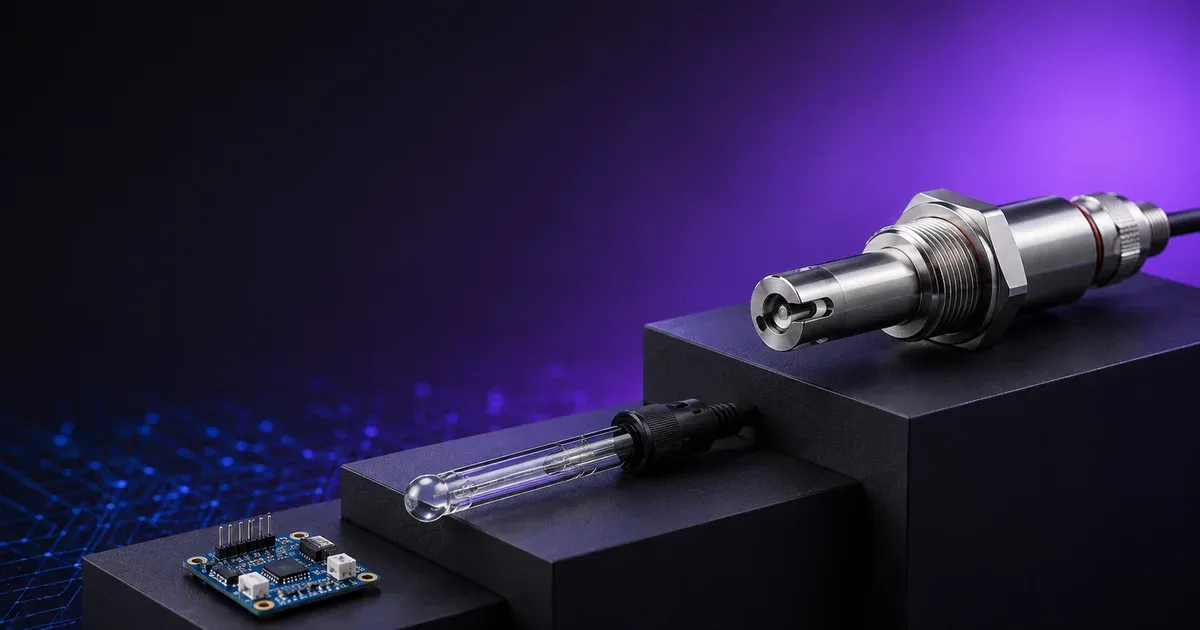
pH & EC/TDS Sensors: From Hobby Probes to Inline Process Instruments — The Complete Quality-Tier Buyer's Guide
By LoopString Team
Quick picks by tier. Hobby → a Gravity/DFRobot analog pH + EC kit. Maker/Prosumer → an Atlas Scientific double-junction probe + isolated EZO circuit. Commercial → an industrial sealed-gel or ISFET probe + 4-20 mA transmitter. Hardened industrial / audited → an inline process pH instrument (Hamilton / Endress+Hauser / Mettler-Toledo) with a replaceable measuring cartridge. Why each wins is below.
The thing that actually bites you: pH probes are consumables
Every other sensor in this series is a device you install and forget. A pH probe is a consumable you maintain. The glass membrane ages, the reference junction slowly clogs with whatever's in your solution, and a probe that reads dead-on today will be 0.3–0.5 pH off in three months if you don't recalibrate it. People buy a $30 probe, mount it, and treat the reading as gospel for a year — and quietly make every decision on bad data.
The price on the box is the cheapest part of pH. The real cost is calibration cadence (how often you have to pull the probe, rinse it, and run a two-point cal against fresh buffers) and probe replacement (every 6–24 months depending on grade and how aggressive your solution is). That maintenance burden — not accuracy — is what separates the tiers. The whole reason industrial pH costs 20× a hobby probe is that it pushes the replacement interval out and makes the swap a cartridge change instead of a re-plumb.
EC/TDS is gentler — conductivity cells drift less and last longer — but it has its own trap: TDS is not measured, it's calculated from EC using a conversion factor, and two meters with different factors disagree on the same water.
The decision axes
- Junction type (pH) — single-junction (cheap, clogs fast) → double-junction (resists fouling) → sealed-gel / ePTFE / ISFET solid-state (no glass to break, longest life).
- Calibration cadence — the dominant running cost. Hobby probes want weekly–monthly two-point cals; industrial cartridges hold cal for months.
- Temperature compensation (ATC) — pH is temperature-dependent. A probe without ATC drifts as the solution warms and cools.
- Lifespan & replaceability — soldered/sealed vs a replaceable measuring cartridge; this sets your true cost of ownership.
- Isolation / ground loops — a pH and an EC probe in the same vessel will fight each other unless their circuits are electrically isolated.
- Interface — raw high-impedance mV (needs a preamp at the probe) → I²C/UART digital circuit → 4-20 mA transmitter → Modbus/HART digital probe with stored calibration.
- Wetted materials & traceable buffers — chemical compatibility of the body, and whether you calibrate against certified reference buffers (the audit requirement).
Tier | Probe | Element | Accuracy | Calibration cadence | Lifespan | Interface | Price (USD) | Best for |
|---|---|---|---|---|---|---|---|---|
Hobby | Analog pH + Gravity/DFRobot board | Single-junction glass | ±0.1–0.2 pH | weekly–monthly | 6–12 mo | Analog (BNC) | $30–60 | Hobby hydro / aquarium |
Prosumer | Atlas double-junction + isolated EZO | Double-junction glass (isolated) | ±0.02 pH | monthly | 12–18 mo | I²C / UART | $80–200 | Small commercial, records |
Commercial | Industrial ISFET / sealed-gel + transmitter | ISFET / ePTFE junction | ±0.05 pH | quarterly | 1–2 yr | 4-20 mA | $200–600 | Process / wash-down |
Industrial | Inline process pH (Memosens) | Replaceable cartridge, digital | ±0.02 pH | months (hot-swap spare) | cartridge | 4-20 mA / HART / Modbus | $600–2000+ | Audited / traceable |
Hobby | Gravity analog EC | 2-electrode contacting | ±2% | with pH cal | ~12 mo | Analog | $50–70 | Hobby nutrient EC |
Commercial | Industrial toroidal conductivity | Inductive (fouling-immune) | ±1% | infrequent | years | 4-20 mA / Modbus | $200–800 | Fouling / process EC |
Walking up the ladder
Hobby — analog probe + Gravity/DFRobot board ($30–60). A single-junction BNC probe and an analog front-end board. Calibrate two-point against 4.0 and 7.0 buffers and you'll get ±0.1–0.2 pH — for a while. Lifespan is typically 6–12 months and it wants frequent recalibration. Stop here if you're running a home hydroponics setup or an aquarium and you check it by hand anyway.
Maker/Prosumer — double-junction probe + isolated digital circuit ($80–200). An Atlas Scientific (or equivalent) double-junction glass probe on an electrically isolated EZO circuit reading over I²C or UART, ±0.02 pH with proper cal, built-in temperature compensation, and a junction that resists clogging far longer. Stop here if you run a small commercial grow or process and keep records you might be asked about.
Commercial — industrial sealed/ISFET probe + 4-20 mA transmitter ($200–600). A sealed-gel or solid-state ISFET probe (no glass bulb to shatter, ePTFE junction that resists fouling) feeding a 4-20 mA transmitter you can run a long way through electrical noise. Field-calibratable, wash-down-rated bodies. Stop here if you have a real process line, harsh media, or wash-down cleaning.
Hardened industrial — inline process pH ($600–2000+). Hamilton, Endress+Hauser, or Mettler-Toledo process instruments with an integral preamp, a replaceable measuring cartridge, and digital memory (Memosens-style) that stores calibration data in the probe — so you calibrate a spare on the bench and hot-swap it in seconds. 4-20 mA / HART / Modbus, calibrated against traceable buffers. You need this tier if an auditor will ask how and when the loop was last calibrated.
Interface & wiring notes (per tier)
- Raw pH probe (high-impedance mV): the signal is microvolt-sensitive and gigaohm-impedance — it must hit a preamp or an isolated ADC right at the probe, never a bare Pi GPIO. Keep BNC connectors bone dry; a film of moisture leaks the signal away.
- Ground loops (the classic failure): a pH probe and an EC probe in the same tank inject current into each other and both readings jump erratically. Fix it with electrically isolated probe circuits (e.g. Atlas EZO isolation) or by measuring them in separate isolated channels.
- EC / TDS: contacting two-electrode cells are cheap but foul; toroidal (inductive) conductivity probes are immune to fouling and the right industrial choice. Always apply temperature compensation — conductivity rises ~2%/°C.
- 4-20 mA / Modbus process probes: loop-powered, run hundreds of metres, read through a 4-20 mA HAT or RS-485 adapter on the Pi.
How LoopString reads every tier — in one dashboard
A Raspberry Pi running LoopString's Node-RED templates reads a $30 analog pH board over I²C and a $1500 Memosens process probe over Modbus into the same dashboard — same live trend, same threshold alerts, and, critically for pH, the same calibration log so you have a defensible record of when each probe was last cal'd and by whom. Prototype on a Gravity kit, move to an inline cartridge probe for production, and your dashboards and history don't change. Wire your probe to a Pi and see it live at app.loopstring.io.
Useful next reads: the greenhouse monitoring use case, the Raspberry Pi automation guide, and the MQTT sensor dashboard overview.
Frequently asked questions
A pH probe is a consumable you maintain, not a device you install and forget. The glass membrane ages and the reference junction slowly clogs with whatever's in your solution, so a probe that reads dead-on today can be 0.3–0.5 pH off in three months without recalibration. You need to pull it, rinse it, and run a two-point cal against fresh 4.0 and 7.0 buffers on a regular cadence — weekly to monthly for hobby probes.
Related posts
- Dosing & Circulation Pumps: From Hobby Peristaltic to Industrial Metering Pumps — The Complete Quality-Tier Buyer's Guide
- Solenoid Valves: From Plastic Direct-Acting to Stainless Process Valves — The Complete Quality-Tier Buyer's Guide
- Fans & Blowers: From PWM PC Fans to Industrial EC Blowers — The Complete Quality-Tier Buyer's Guide