
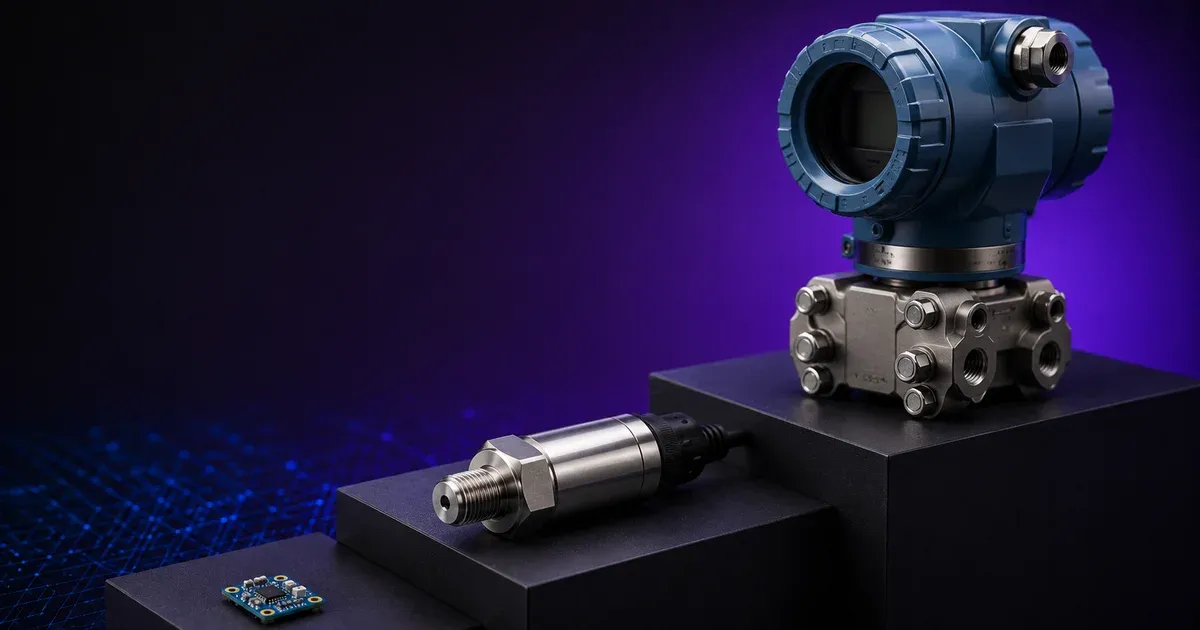
Pressure Sensors: From BMP390 to Rosemount — The Complete Quality-Tier Buyer's Guide
By LoopString Team
Quick picks by tier. Hobby (barometric/altitude) → Bosch BMP390. Maker (high-resolution barometric/depth) → TE MS5611 / MS5803. Commercial (line/process pressure) → a 4-20 mA piezoresistive transmitter. Hardened industrial / audited → a Rosemount 3051 or WIKA process transmitter. Why each wins is below — but read the next section first, because "pressure" means two very different things.
The thing that actually bites you: which kind of pressure?
More pressure-sensing projects fail at the selection stage than anywhere else, because the word "pressure" covers two unrelated jobs and people buy the wrong family of part:
- Barometric / atmospheric — a tiny MEMS chip (BMP390, MS5611) reading ambient air pressure for weather, altitude, or water depth. Cheap, I²C, exquisitely sensitive to small changes around 1000 hPa, and completely unsuited to measuring the pressure inside a pipe or tank.
- Line / process pressure — a piezoresistive transducer with a wetted diaphragm and a pressure port (NPT/G thread) measuring bar or psi inside a system. This is what you want for a pump, an air line, a hydraulic circuit, or a tank.
The second thing that bites you is the reference: absolute vs gauge vs differential.
- Absolute — measured against vacuum. Barometers are absolute. A tank-level reading taken with an absolute sensor moves every time the weather changes.
- Gauge — measured against local atmosphere (it has a vent). "30 psi in the tyre" is gauge. This is what you want for most line-pressure jobs.
- Differential — the pressure difference between two ports. This is how you measure flow across an orifice, filter clogging, or tank level in a sealed vessel.
Pick the wrong reference and your readings will drift with the barometer or sit stubbornly 14.7 psi off. So the real first question isn't accuracy — it's "barometric or line pressure, and absolute, gauge, or differential?"
The decision axes
- Pressure type — barometric MEMS vs process transducer; they are not interchangeable.
- Reference — absolute / gauge / differential (and sealed-gauge for submersion).
- Range & overpressure — size the range to your working pressure with headroom; check the burst/overpressure rating so a spike doesn't destroy the diaphragm.
- Accuracy — hobby barometric parts quote relative accuracy in pascals; process transmitters quote % of full-scale (FS) — e.g. ±0.25% FS — which is what regulators care about.
- Wetted materials — the diaphragm and port metal must survive your media (water, oil, refrigerant, corrosives).
- Interface — I²C/SPI MEMS → ratiometric analog (0–5 V) → 4-20 mA loop → HART/Modbus digital.
- Traceable calibration — the audit requirement; only process-grade transmitters ship a certificate.
Tier | Sensor | Element | Reference | Accuracy | Range (example) | Interface | Price (USD) | Best for |
|---|---|---|---|---|---|---|---|---|
Hobby | Bosch BMP390 / BMP280 | Barometric MEMS | Absolute | ±0.5 hPa abs (sub-Pa rel) | 300–1250 hPa | I²C / SPI | $5–12 | Weather, altitude, indoor |
Prosumer | TE MS5611 / MS5803 | Barometric MEMS (hi-res) | Absolute | ±1.5 mbar | 10–1200 mbar (MS5803 water-rated) | I²C / SPI | $15–30 | Precise altitude / water depth |
Commercial | Piezoresistive 4-20 mA transmitter | Process transducer | Gauge / Abs / Diff | ±0.25–0.5% FS | sized to system | 4-20 mA / 0–5 V | $50–300 | Pumps, lines, tanks |
Industrial | Rosemount 3051 / WIKA | Process transducer | Gauge / Abs / Diff | ±0.025–0.075% FS | configurable | 4-20 mA / HART / Modbus | $800–3000+ | Custody / safety / audited |
Walking up the ladder
Hobby — Bosch BMP390 / BMP280 ($5–12). Barometric MEMS on an I²C/SPI breakout, excellent relative resolution (sub-pascal on the BMP390), onboard temperature. Perfect for weather stations, altitude/vario, and indoor pressure trends. It is absolute and it is not a line-pressure sensor. Stop here if you're sensing the atmosphere.
Maker — TE MS5611 / MS5803 ($15–30). Higher-resolution barometric parts; the MS5803 variants are water-rated and the go-to for DIY depth/level sensing in open water. Same caveat — still atmospheric/absolute, still not for pipe pressure. Stop here if you need precise altitude, weather, or water-depth resolution.
Commercial — piezoresistive 4-20 mA transmitter ($50–300). Now you cross into real process pressure: a stainless wetted diaphragm, a threaded port, gauge or absolute or differential reference, ±0.25–0.5% FS, and a 4-20 mA loop that runs through electrical noise without losing a count. Field-zeroable. Stop here if you're monitoring a pump, compressor, hydraulic line, or tank and don't face a formal audit.
Hardened industrial — Rosemount 3051 / WIKA ($800–3000+). Reference-class accuracy (±0.025–0.075% FS), HART/4-20 mA, configurable absolute/gauge/differential, remote diaphragm seals for hot or corrosive media, and traceable calibration certificates. The differential variant is the standard way to infer flow and sealed-tank level. You need this tier if a regulator, a custody-transfer requirement, or a safety case depends on the number.
Interface & wiring notes (per tier)
- BMP390 / MS5611 (I²C/SPI): SDA/SCL or the SPI bus + pull-ups; keep the part out of direct airflow and away from self-heating sources, which shift the reading. Watch for I²C address clashes with other breakouts.
- Ratiometric analog transmitters (0–5 V): the output scales with supply voltage, so feed the sensor and the Pi's ADC reference from the same clean rail or your readings track supply noise.
- 4-20 mA loop: loop-powered, immune to voltage drop over hundreds of metres; read through a 4-20 mA HAT or a precision sense resistor + ADC. Size the loop supply for the resistance.
- HART / Modbus process transmitters: digital configuration of range and damping; read over RS-485 or a HART modem. Always respect the overpressure rating when plumbing into a system that can spike.
How LoopString reads every tier — in one dashboard
A Raspberry Pi running LoopString's Node-RED templates reads a $6 BMP390 over I²C and a $1200 Rosemount transmitter over 4-20 mA into the same dashboard — same live trend, same threshold and rate-of-change alerts, same history. Prototype a tank-level idea on a hobby part, then drop in a process transmitter for the real install without rebuilding your dashboards or alerts. Wire your sensor to a Pi and see it live at app.loopstring.io.
Useful next reads: the Raspberry Pi automation guide, the MQTT sensor dashboard overview, and Raspberry Pi industrial monitoring.
Frequently asked questions
No. A barometric MEMS chip like the BMP390 or MS5611 reads ambient air pressure for weather, altitude, or water depth — it's completely unsuited to measuring pressure inside a pipe, pump, or tank. For line or process pressure you need a piezoresistive transducer with a wetted diaphragm and a threaded NPT/G pressure port. Most pressure projects fail at this selection stage by buying the wrong family of part.
Related posts
- Dosing & Circulation Pumps: From Hobby Peristaltic to Industrial Metering Pumps — The Complete Quality-Tier Buyer's Guide
- Solenoid Valves: From Plastic Direct-Acting to Stainless Process Valves — The Complete Quality-Tier Buyer's Guide
- Fans & Blowers: From PWM PC Fans to Industrial EC Blowers — The Complete Quality-Tier Buyer's Guide