
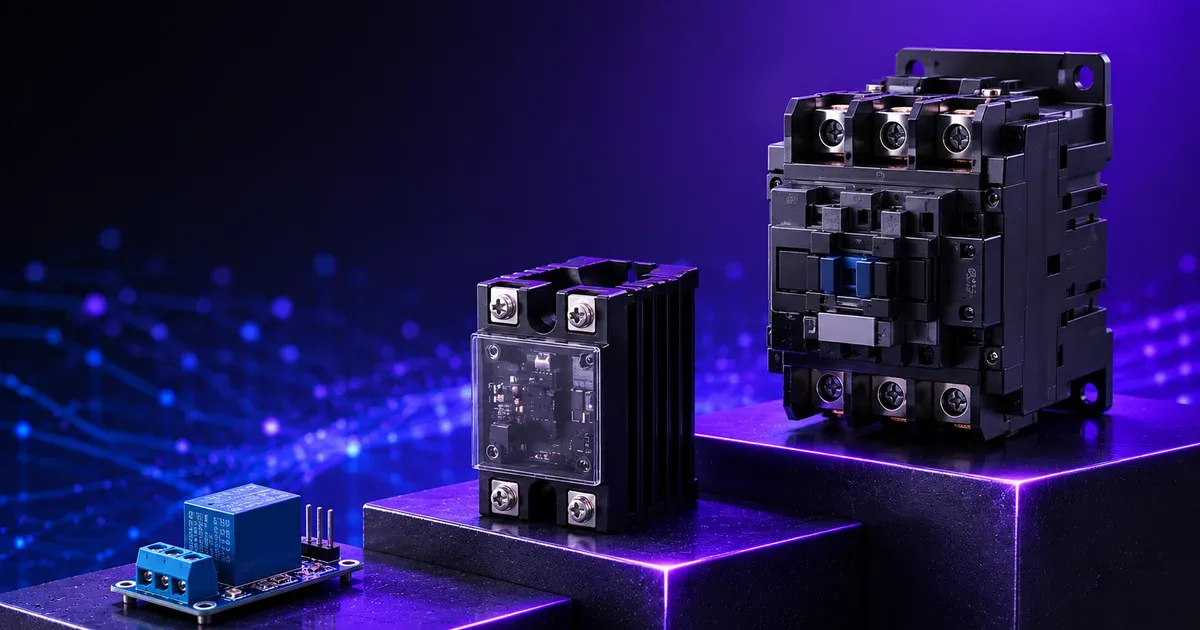
Relays & Contactors: From Mechanical Relays to DIN Contactors — The Complete Quality-Tier Buyer's Guide
By LoopString Team
Quick picks by tier. Hobby → a bare mechanical relay module (SRD/Songle) off a GPIO. Maker/Prosumer → a quality DIN relay (Omron G2R, Finder) or a zero-cross solid-state relay (SSR) for resistive AC loads. Commercial → a DIN-rail relay/SSR sized to the real load, or a contactor for motors and heaters. Hardened industrial / audited → an IEC/UL motor contactor (Schneider, ABB, Siemens) with an overload relay. Why each wins is below — but if you just need a name, start there.
The thing that actually bites you: amps don't tell you what the load does to the contacts
The universal switching mistake is sizing a relay by current alone — "my load is 8 A, this relay says 10 A, done" — and watching the contacts weld or burn out in weeks. The amp rating is for a resistive load. The moment you switch a motor, a transformer, a solenoid, or a capacitive supply, you hit inrush currents many times the running current and an inductive arc on turn-off that erodes the contacts every cycle. That's why switching devices carry utilisation categories: AC-1 (resistive/heating) vs AC-3 (motor starting). A contactor rated 25 A AC-1 might only be good for a 5.5 kW motor at AC-3 — the same contacts, a very different real rating.
The second thing people skip is switching life and arc suppression. Mechanical relays are rated for a finite number of operations (often ~100k at full load), and that number collapses without snubbing. An inductive load needs a flyback diode (DC) or an RC snubber / MOV (AC) across the contacts or the coil, or the arc eats the contacts fast. Cheap relay boards ship with none of that — and often with questionable creepage/clearance for mains and an opto that isn't truly isolating the way the silkscreen implies.
SSRs solve the wear problem (no contacts, millions of operations, silent, fast) but bring their own rules: they leak a few mA when off, drop ~1 V (so they need a heatsink at any real current), and want zero-cross switching for resistive loads vs random-fire for phase control. And unlike a mechanical relay, an SSR offers no true galvanic air-gap isolation when off.
So the real question isn't "can it switch my amps?" — it's "will it survive a million cycles of my load type, with the right arc suppression, without welding or cooking?"
The decision axes
- Load type / utilisation category — resistive (AC-1) vs motor (AC-3) vs inductive/capacitive. The spec that actually sizes the device.
- Inrush vs running current — motors, transformers, and LED/SMPS supplies pull large startup surges the steady-state rating ignores.
- Switching life (mechanical/electrical cycles) — finite for relays/contactors; effectively unlimited for SSRs.
- Arc suppression — flyback diode (DC), RC snubber/MOV (AC); mandatory for inductive loads and contact life.
- Isolation — mechanical relay/contactor gives a true open-air gap when off; an SSR does not (and leaks).
- Heat — SSRs drop ~1 V and need heatsinking; contactor coils and aux contacts have their own thermal limits.
- Switching style — zero-cross SSR (resistive) vs random-fire (inductive/phase control); mechanical for full isolation.
- Safety & ratings — creepage/clearance, UL/IEC listing, and an overload relay for motor protection.
*TierDeviceElement**Arc suppressionInterface*Price (USD)**Best forHobbyBare mechanical relay module (SRD / Songle)Mechanical relayAC-1 small loads~100k opsTrue air gapNone (add snubber)GPIO (relay board)$1–5Lamps, small DC/AC, learningProsumerQuality DIN relay (Omron/Finder) / zero-cross SSRRelay or SSRAC-1 resistiveRelay finite / SSR ~unlimitedRelay yes / SSR no (leaks)Snubber / heatsinkGPIO via driver$10–40Real heaters, appliancesCommercialSized DIN relay/SSR or contactorRelay / SSR / contactorAC-1 or AC-3 (motor)per categoryper deviceSnubber / MOVInterface relay$20–100Motors, large heaters, panelsIndustrialIEC/UL contactor + overload (Schneider, ABB, Siemens)Contactor + overloadAC-3 motor dutyHigh (rated)True air gapArc chambersCoil via interface relay$50–500+Motor starting, audited panels
Walking up the ladder
Hobby — bare mechanical relay module ($1–5). A Songle/SRD relay on a little board with an opto and a transistor driver. Genuinely useful for switching a lamp, a small DC load, or a low-power AC appliance from a GPIO while you learn. Treat its mains ratings and isolation with suspicion, add a snubber for anything inductive, and don't trust it for continuous or safety-critical switching. Stop here if the load is small, intermittent, and non-critical.
Maker/Prosumer — quality DIN relay or zero-cross SSR ($10–40). An Omron/Finder relay in a DIN socket gives real, spec'd contact ratings, replaceability, and aux contacts; a zero-cross SSR silently switches resistive AC (heaters, lamps) for millions of cycles — heatsinked, and remembering it leaks when off. Stop here if you're switching real heaters or appliances and want a part you can trust and replace.
Commercial — DIN relay/SSR sized to the load, or a contactor ($20–100). Now you match the device to the load type: a properly rated SSR or interface relay for resistive/light duty, or a contactor with AC-3 motor rating and aux contacts for motors and large heaters. Stop here if you have motors, large heaters, or multi-load panels and need ratings that hold up.
Hardened industrial — IEC/UL contactor + overload relay ($50–500+). Schneider, ABB, Siemens contactors with proper AC-3 motor duty, a matched thermal/electronic overload relay for motor protection, arc chambers, and panel-grade listing and documentation. You need this tier if you're starting motors, building an audited control panel, or protecting equipment and people at scale.
Interface & wiring notes (per tier)
- Relay module (GPIO): mind active-high vs active-low triggering and whether the board's opto is truly isolated; power the relay coil from a separate supply, not the Pi's 3.3 V rail. Add a flyback diode (DC load) or RC snubber/MOV (AC) for anything inductive.
- SSR (control + load): a 3–32 V DC control input switches the AC load; heatsink it (roughly derate hard above a couple of amps), pick zero-cross for resistive and random-fire for inductive/phase control, and remember the few-mA off-state leakage can keep tiny loads (neon indicators, small relays) faintly alive.
- Contactor: drive the coil (often 24 V or mains) via an interface relay from the Pi — don't switch a contactor coil directly from a GPIO; use the aux contact for state feedback and a matched overload relay for motors.
- Across the board: never switch a mains contactor coil straight off a GPIO, and keep mains wiring, creepage, and fusing to code — the Pi side stays low-voltage and isolated.
A note on the rating that lies: a "30 A" relay is a resistive number. Switch an inductive or motor load and the real, safe rating can be a third of that, and contact life shrinks without a snubber. Size by utilisation category (AC-1 vs AC-3), account for inrush, and suppress the arc — or buy a contactor built for the duty.
How LoopString controls every tier — from one dashboard
Here's the part that makes the whole ladder moot from a software standpoint: a Raspberry Pi running LoopString's Node-RED templates drives a $2 relay module and an industrial contactor from the exact same dashboard — same on/off controls, same schedules, same conditional automation rules, same activity log and duty-cycle tracking. Commands flow from the dashboard through the edge API (over Tailscale) to Node-RED on the Pi, which switches the output; the control logic lives on the Pi, not the cloud. You can prototype with a relay board and graduate to a contactor for the real motor without rewriting any automation. Pick the tier your load actually needs using the table above, wire it to a Pi, and switch it from anywhere at app.loopstring.io.
Useful next reads: the Raspberry Pi automation guide, the Raspberry Pi industrial monitoring guide, and the MQTT sensor dashboard overview.
Frequently asked questions
You switched an inductive/motor load with a relay sized for resistive current. Motors and transformers pull large inrush at startup and arc on turn-off, eroding or welding contacts — especially without arc suppression. Size by utilisation category (AC-3 for motors, not AC-1), add a flyback diode (DC) or RC snubber/MOV (AC), or use a contactor built for motor duty.
Related posts
- Dosing & Circulation Pumps: From Hobby Peristaltic to Industrial Metering Pumps — The Complete Quality-Tier Buyer's Guide
- Solenoid Valves: From Plastic Direct-Acting to Stainless Process Valves — The Complete Quality-Tier Buyer's Guide
- Fans & Blowers: From PWM PC Fans to Industrial EC Blowers — The Complete Quality-Tier Buyer's Guide