
Soil Moisture Sensors: From Resistive Probes to TDR — The Complete Quality-Tier Buyer's Guide
By LoopString Team
Quick picks by tier. Avoid → bare resistive (two-prong) probes. Hobby → a capacitive v2.0 probe. Maker/Prosumer → a quality capacitive probe with a proper ADC, or a Watermark for irrigation tension. Commercial → a METER TEROS 10/12 (FDR, factory-calibrated VWC, SDI-12). Hardened industrial / research → a TDR probe or a tensiometer. Why each wins is below.
The thing that actually bites you: the cheap probe corrodes, and nothing reads true moisture
Two failure modes define this whole category.
First, corrosion. The classic two-prong resistive soil probe works by passing current between bare electrodes through the soil. Those electrodes electrolytically corrode — often visibly within weeks in moist soil — and as they degrade the readings drift meaningless. People deploy a $3 resistive probe, watch it read beautifully for a month, and never realise it's been lying ever since. Capacitive probes solve this by sensing through an insulating coating with no exposed metal, which is why corrosion lifespan is the first rung of the ladder.
Second, calibration to a real quantity. Almost every cheap probe outputs an arbitrary "wetness" number, not volumetric water content (VWC) — the actual fraction of water in the soil. That number depends on your specific soil type: the same probe reads differently in sand, loam, and clay. A raw capacitive reading is fine for "water when it drops below X," but it is not a VWC measurement. Getting true, soil-corrected VWC is exactly what the upper tiers (factory-calibrated FDR, TDR) sell you.
And there's a quiet third option that confuses buyers: tensiometers and granular-matrix sensors measure water potential (tension, in kPa), not water content. For irrigation scheduling, tension is often the better quantity — it tells you how hard the plant has to work to pull water — but it answers a different question than VWC.
So the real question isn't "what's the reading?" — it's "will this probe survive a season in wet soil, and is its number arbitrary, true VWC, or water potential?"
The decision axes
- Sensing principle — resistive (corrodes, arbitrary) → capacitive (durable, arbitrary-to-calibrated) → FDR/capacitance (factory VWC) → TDR (reference VWC) → tensiometer/GMS (water potential).
- Corrosion lifespan — weeks (resistive) to years (sealed capacitive / industrial).
- What it actually reports — arbitrary index, true VWC (%), or water potential (kPa).
- Soil calibration — whether the device is factory-calibrated and how much soil-specific correction it needs.
- Interface — analog index → I²C → SDI-12 / RS-485 (the field-instrument standard) → 4-20 mA.
- Ingress / burial rating — fully potted and rated for permanent burial, or a hobby board that rots at the cable joint.
- Depth & profile — single-point vs a profile probe reading several depths.
Tier | Sensor | Principle | Reports | Corrosion lifespan | Soil calibration | Interface | Price (USD) | Best for |
|---|---|---|---|---|---|---|---|---|
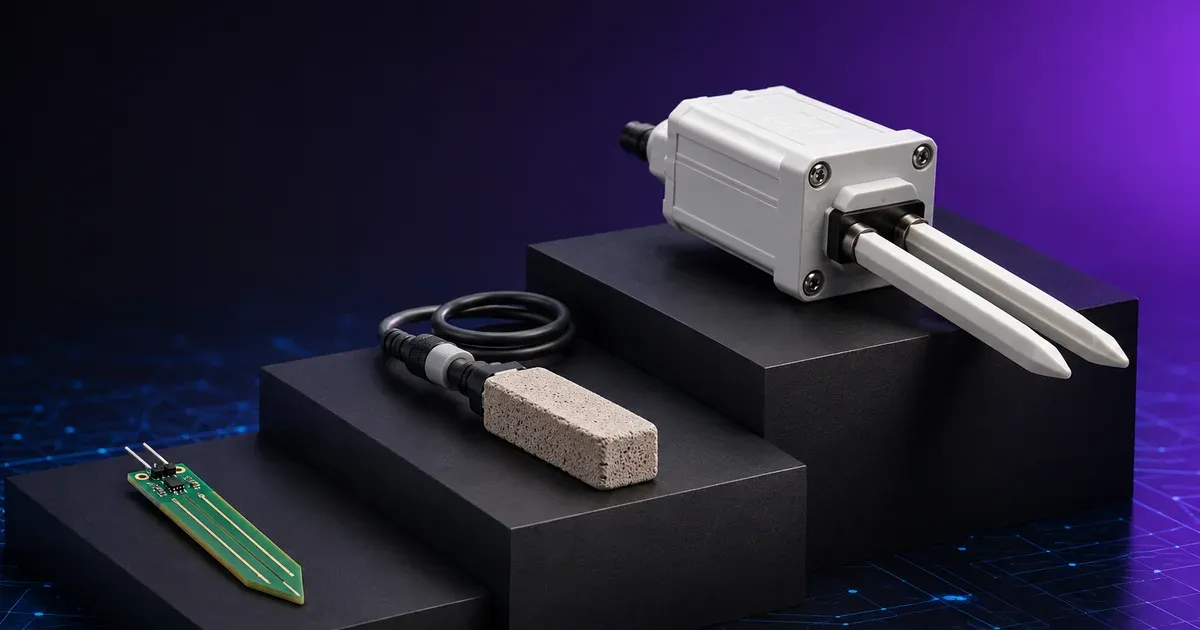
Avoid | Resistive two-prong | Resistive | Arbitrary index | weeks (corrodes) | none | Analog (ADC) | $2–5 | Demo only — never bury |
Hobby | Capacitive v2.0 | Capacitive | Arbitrary index | years (pot the cable joint) | none | Analog (ADC) | $5–10 | Pots, hobby beds |
Prosumer | Quality capacitive / Watermark | Capacitive / granular-matrix | Index / tension (kPa) | years | minimal | Analog / resistance | $15–50 | Gardens, beds, irrigation |
Commercial | METER TEROS 10 / 12 | FDR / capacitance | True VWC % (+EC/temp on 12) | years (burial-rated) | factory-calibrated | SDI-12 | $150–300 | Agronomy, research plots, zones |
Industrial | TDR probe / tensiometer | TDR / tensiometer | Reference VWC / water potential | years | soil-independent (TDR) | SDI-12 / RS-485 / analog | $300–2000+ | Research, regulatory, precision ag |
Walking up the ladder
Avoid — resistive two-prong probe ($2–5). Exposed electrodes corrode within weeks in moist soil and the reading drifts to nonsense. Useful only for a one-off demo or a houseplant you'll re-poke by hand. Don't bury one and trust it.
Hobby — capacitive v2.0 probe ($5–10). Senses through an insulating coating, so no electrolytic corrosion, analog output. The honest workhorse of DIY plant watering. The cheap boards still rot at the cable-to-board joint if water wicks in — pot that junction. The reading is an arbitrary index, not VWC. Stop here if you just need "water when dry" for pots or a hobby bed.
Maker/Prosumer — quality capacitive + good ADC, or a Watermark ($15–50). A better-built capacitive probe read through a clean ADS1115-class ADC gives stable, repeatable index values you can map to thresholds; a Watermark granular-matrix sensor instead gives you tension for smarter irrigation. Stop here if you run a serious garden, a small farm zone, or a greenhouse bed and want repeatable, low-maintenance readings.
Commercial — METER TEROS 10/12 (FDR, $150–300). A potted, burial-rated FDR/capacitance probe that outputs factory-calibrated volumetric water content over SDI-12 (the TEROS 12 adds temperature and EC). This is the jump from "arbitrary wetness" to a real VWC number you can act on and compare across sites. Stop here if you need trustworthy VWC for agronomy, research plots, or multi-zone irrigation.
Hardened industrial / research — TDR probe or tensiometer ($300–2000+). Time-domain reflectometry is the reference method for VWC — largely soil-independent, ±1–2% accuracy — and proper tensiometers give laboratory-grade water potential for irrigation science. This is the audited/research tier. You need this tier if your data has to stand up in a research paper, a regulatory filing, or a precision-ag model.
Interface & wiring notes (per tier)
- Resistive / capacitive analog: read the analog output through a dedicated ADC (the Pi has no analog input) such as an ADS1115; power capacitive probes from a stable 3.3 V and pot the cable joint against moisture ingress.
- SDI-12 (the field standard): TEROS and most professional probes speak SDI-12, a low-speed digital bus designed for long cable runs and multi-drop; the Pi reads it through an SDI-12 HAT or a USB adapter. One bus can address many probes.
- RS-485 / 4-20 mA industrial probes: differential pair + termination for Modbus, or a loop-powered 4-20 mA output for the longest, noisiest runs.
- Burial: only deploy probes explicitly rated for permanent burial; everything else fails at the cable entry within a season.
How LoopString reads every tier — in one dashboard
A Raspberry Pi running LoopString's Node-RED templates reads a $6 capacitive probe through an ADC and a $250 TEROS 12 over SDI-12 into the same dashboard — same live trend, same dry-threshold alerts that can trigger a valve, same history. Prototype zone watering on a capacitive probe, then upgrade to factory-calibrated VWC for the real deployment without rebuilding anything. Wire your probe to a Pi and see it live at app.loopstring.io.
Useful next reads: the greenhouse monitoring use case, the Raspberry Pi automation guide, and the MQTT sensor dashboard overview.
Frequently asked questions
The classic two-prong resistive probe passes current between bare metal electrodes through the soil, and those electrodes electrolytically corrode — often visibly within weeks in moist soil. As they degrade the readings drift to nonsense, but the probe keeps producing a plausible-looking number, so people never realize it has been lying. Capacitive probes avoid this by sensing through an insulating coating with no exposed metal.
Related posts
- Dosing & Circulation Pumps: From Hobby Peristaltic to Industrial Metering Pumps — The Complete Quality-Tier Buyer's Guide
- Solenoid Valves: From Plastic Direct-Acting to Stainless Process Valves — The Complete Quality-Tier Buyer's Guide
- Fans & Blowers: From PWM PC Fans to Industrial EC Blowers — The Complete Quality-Tier Buyer's Guide