
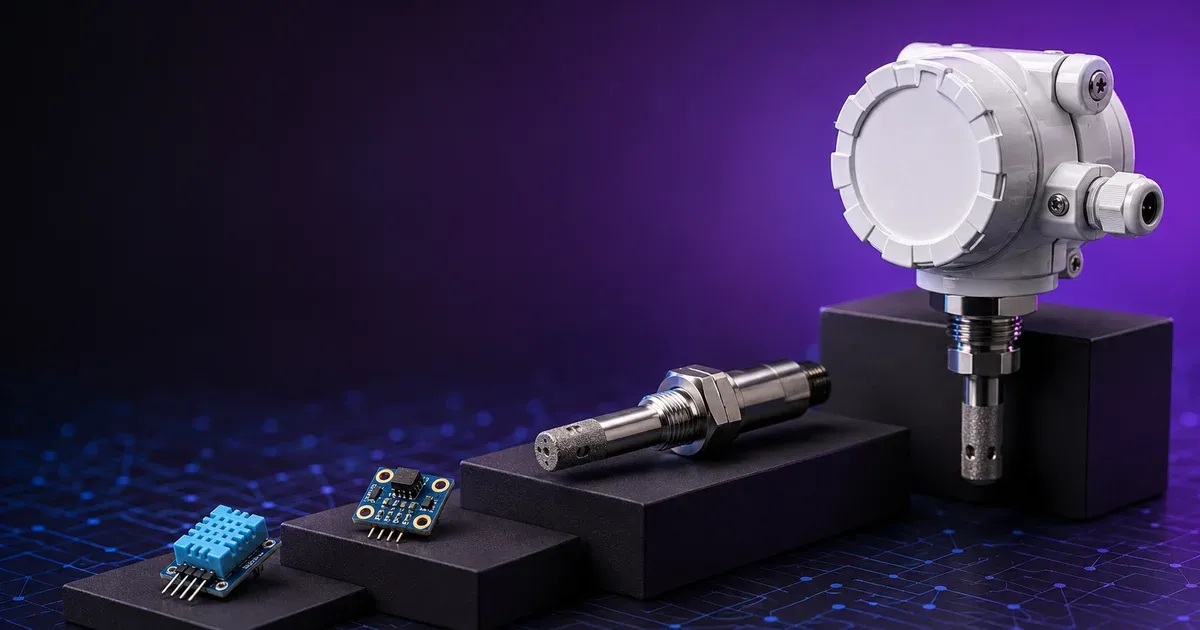
Temperature & Humidity Sensors: From DHT22 to Vaisala — The Complete Quality-Tier Buyer's Guide
By LoopString Team
Quick picks by tier — Hobby → DHT22 (or AHT20 for I²C). Maker/Prosumer → Sensirion SHT31-D. Light compliance → SHT85. Commercial → an RS-485 Modbus RHT probe. Hardened industrial / audited → Vaisala HMP110. Why each wins is below.
Accuracy is the headline. Drift and condensation are what actually bite you.
Everyone shops for temperature and humidity sensors by reading one number off a datasheet: "±2% RH, ±0.3 °C — good enough." Then eighteen months into a deployment the readings have quietly walked 4% off true, a cold-storage door cycle fogs the element and humidity pins at 99%, and nobody notices until a batch is out of spec.
The headline accuracy number is the easy part. Three things decide whether you trust a reading in production:
- Drift (aging). Cheap capacitive-polymer elements can wander ~1% RH per year — more in dirty or high-humidity air. A Sensirion CMOSens part holds under 0.25% RH/yr. Over three years that's the difference between "recalibrate annually" and "set and forget."
- Condensation & ingress. A bare PCB sensor is fine until the dew point is crossed and water bridges the element; recovery — and survival — depends on the sensor design and its enclosure or IP rating.
- Interface. This decides how far the sensor can sit from the Pi, how many you can chain, and how noisy the signal is. A 1-wire hobby part runs ~20 cm on a breadboard; a 4-20 mA or RS-485 industrial probe runs hundreds of metres through electrical noise without losing a count.
So the real question isn't "how accurate is it?" — it's how much do I trust this reading in 18 months, in this environment, at this distance? That's the ladder this guide walks.
The decision axes
- Temperature accuracy — usually the least of your worries; even hobby parts hit ±0.5 °C.
- RH accuracy and repeatability — repeatability (does it give the same number twice?) matters as much as absolute accuracy for control loops.
- Drift per year — the spec that separates the tiers more than any other.
- Interface — 1-wire (proprietary) → I²C → RS-485 Modbus → analog 4-20 mA / 0-10 V, roughly cheap-and-close to expensive-and-far.
- Condensation tolerance / IP rating — bare board → conformal-coated → filter-capped → fully sealed probe.
- Calibration — none → factory-calibrated → field-calibratable → NIST/traceable certificate (the audit requirement).
- Price and lifespan — and crucially, replacement cost and ease: soldered vs pin-type vs interchangeable probe head.
Tier | Sensor | Technology | Temp accuracy | RH accuracy | Drift / yr | Interface | Price (USD) | Best for |
|---|---|---|---|---|---|---|---|---|
Hobby | DHT22 / AM2302 | Capacitive polymer | ±0.5 °C | ±2–5% | ~1%/yr | 1-wire (proprietary) | $4–10 | Prototypes, non-critical monitoring |
Hobby | AHT20 | Capacitive (CMOS) | ±0.3 °C | ±2–3% | ~0.5%/yr | I²C | $3–6 | Better hobby default than DHT22 |
Hobby | Bosch BME280 | Capacitive + MEMS | ±0.5–1.0 °C | ±3% | ~1%/yr | I²C / SPI | $6–15 | Maker projects that also want pressure |
Prosumer | Sensirion SHT31-D | CMOSens | ±0.3 °C | ±2% | <0.25%/yr | I²C | $12–18 | The standardize-on default |
Prosumer | Sensirion SHT85 | CMOSens (pin-type) | ±0.1 °C | ±1.5% | <0.25%/yr | I²C | $35–55 | Field-replaceable, light compliance |
Commercial | RS-485 Modbus RHT probe | Industrial probe | ±0.3–0.5 °C | ±2–3% | <0.5%/yr | RS-485 Modbus, IP65 | $80–200 | Multi-zone, long runs, wash-down |
Industrial | Vaisala HMP110 | Interchangeable head | ±0.2 °C | ±1.5% | negligible | Analog / Modbus | $400–700 | Audited / GxP / traceable cal |
Walking up the ladder
Hobby — DHT22 / AHT20 / BME280 ($4–15). Perfect for prototyping, learning, and non-critical monitoring — a spare-room grow tent, a weather project. The DHT22 is the classic, but it's slow (~0.5 Hz), uses a fiddly proprietary 1-wire protocol, and drifts. The AHT20 is a strictly better hobby choice — true I²C, ±0.3 °C / ±2–3% RH, a couple of dollars. The BME280 earns its place by bundling barometric pressure on the same I²C breakout. Stop here if nothing bad happens when the reading is wrong.
Maker/Prosumer — Sensirion SHT31-D ($12–18). The part to standardize on for anything you actually care about: ±0.3 °C, ±2% RH, genuine I²C, and — the headline — drift under 0.25% RH/yr. It's the smallest jump in price that buys the biggest jump in trustworthiness. Stop here if you run a real grow op, a small cold room, or a server closet and have no auditor.
Prosumer+ / light-commercial — Sensirion SHT85 ($35–55). Same CMOSens accuracy class (±0.1 °C / ±1.5% RH) in a pin-type package designed to be replaced without rework, and field-calibratable. This is where you go when "recalibrate it" needs to be a 30-second swap, not a soldering job. Stop here if you keep records but don't need a traceable certificate.
Commercial — RS-485 Modbus RHT probe ($80–200). Now you're buying the interface and enclosure as much as the element: IP65 housing, a stainless or filter-capped probe, RS-485 Modbus RTU so you can multi-drop a dozen on one cable run hundreds of metres long, and field calibration. Stop here if you have multiple zones, long cable runs, or a wash-down environment.
Hardened industrial — Vaisala HMP110 ($400–700). Negligible drift, interchangeable pre-calibrated probe heads, analog and Modbus options, and — the reason people pay for it — NIST-traceable calibration certificates that satisfy GxP / FDA / pharma / metrology auditors. You need this tier if a regulator or customer will ask to see the cal cert.
Interface and wiring notes
- DHT22 (1-wire proprietary): one GPIO plus a pull-up. Timing-sensitive; keep leads short (under 20 cm) and don't poll faster than ~0.5 Hz.
- AHT20 / BME280 / SHT31 / SHT85 (I²C): SDA/SCL plus pull-ups. Watch for address clashes — SHT31 is 0x44/0x45, BME280 0x76/0x77; put clashing parts behind a TCA9548A I²C mux. Keep the bus under ~1 m or use an extender.
- Modbus RS-485 probe: A/B differential pair plus ground, 120 Ω termination at the ends. Runs hundreds of metres, multi-drop up to 32 nodes. Needs a USB-RS485 or HAT adapter on the Pi.
- Vaisala / analog 4-20 mA: loop-powered, immune to voltage drop over distance; reads through an ADC or 4-20 mA HAT. Intrinsically-safe variants exist for hazardous areas.
Beware fake Sensirion and Bosch parts. The accuracy and drift specs above are for genuine parts. Marketplace clones of the SHT31 and BME280 are common and routinely miss spec by 2–3× on humidity. Buy from authorized distributors (DigiKey, Mouser, Adafruit, or Sensirion direct) when the number matters.
How LoopString reads every tier — in one dashboard
Here's the part that makes the whole ladder moot from a software standpoint: a Raspberry Pi running LoopString's Node-RED templates reads a $5 DHT22 and a $500 Vaisala probe into the exact same dashboard. I²C, 1-wire, RS-485 Modbus, 4-20 mA — they all normalize into the same live telemetry, the same threshold alerts, the same compliance log. You can prototype on an AHT20 and swap in a Modbus probe for production without touching your dashboards, alerts, or history.
That means you don't have to pick your sensor and your software at the same time. Pick the sensor tier your job actually needs, wire it to a Pi, and LoopString handles the rest.
Reads any sensor, any tier — wire your temperature and humidity sensor to a Raspberry Pi and see it live in minutes. Start free at app.loopstring.io.
Frequently asked questions
For a hobby tent, yes. For anything you sell or audit, no — its ±2–5% RH and ~1%/yr drift will walk out of spec. Step up to a Sensirion SHT31 (around $15) for real grows.
Related posts
- Dosing & Circulation Pumps: From Hobby Peristaltic to Industrial Metering Pumps — The Complete Quality-Tier Buyer's Guide
- Solenoid Valves: From Plastic Direct-Acting to Stainless Process Valves — The Complete Quality-Tier Buyer's Guide
- Fans & Blowers: From PWM PC Fans to Industrial EC Blowers — The Complete Quality-Tier Buyer's Guide