
Vibration Sensors: From MEMS Accelerometers to IEPE Piezo — The Complete Quality-Tier Buyer's Guide
By LoopString Team
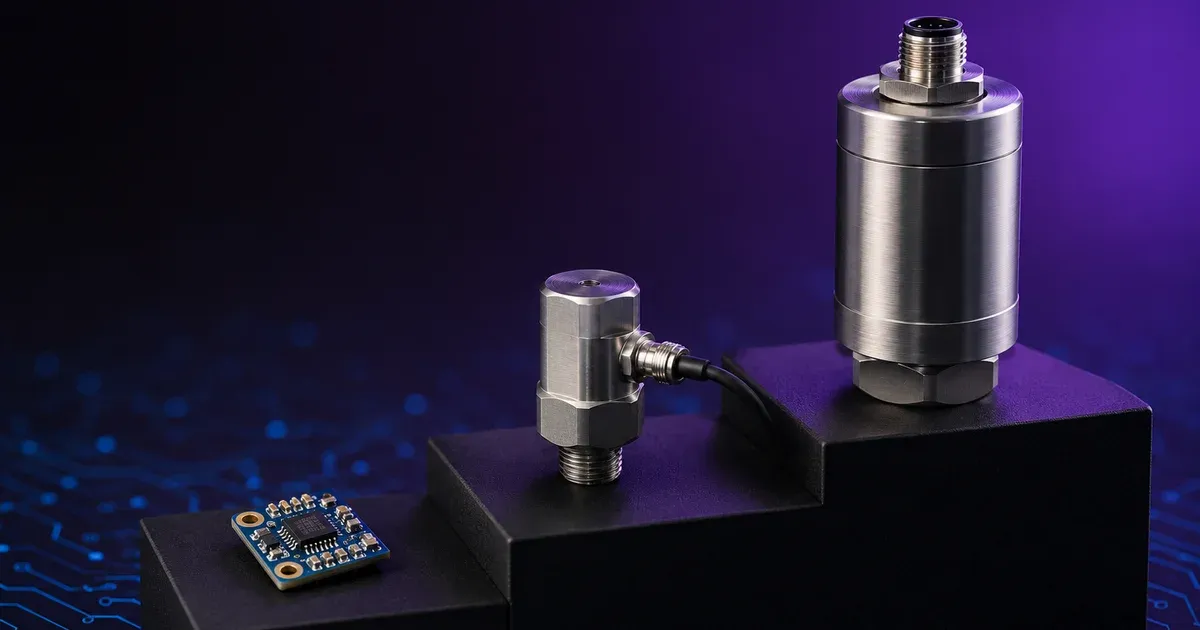
Quick picks by tier. Hobby → a MEMS accelerometer breakout (ADXL345, MPU6050) for tilt and gross motion. Maker/Prosumer → a low-noise wide-bandwidth MEMS (ADXL355/1002, IIS3DWB). Commercial → an IEPE/ICP piezoelectric accelerometer + signal conditioner for FFT bearing analysis. Hardened industrial / audited → a 4-20 mA industrial vibration transmitter or an eddy-current proximity probe for machinery protection. Why each wins is below — but if you just need a name, start there.
The thing that actually bites you: bandwidth, not the g-rating
The classic vibration-monitoring mistake is buying an accelerometer by its g-range and sample rate, bolting it on with a magnet, and expecting it to catch a failing bearing. It won't — because the faults you're hunting live at frequencies the sensor and its mounting can't see. A rolling-element bearing announces its death at defect frequencies (BPFO, BPFI, ball-spin) up in the kilohertz range, often as small, high-frequency spikes riding on the rotation. A cheap MPU6050 is usable to maybe ~1 kHz with a noise floor that buries those spikes. So it dutifully reports "vibration normal" right up until the bearing fails.
The second silent killer is mounting. The same accelerometer has a wildly different usable frequency range depending on how it's attached: a stud mount might be good to 10+ kHz, an adhesive pad to a few kHz, and a handheld magnet to maybe 1–2 kHz. Mount a good sensor badly and you've thrown away the bandwidth you paid for.
And you have to measure the right quantity. Overall-level trending for machine health (ISO 10816/20816) is done in velocity (mm/s RMS); spectral diagnostics of bearings and gears is done in acceleration (g). A sensor and pipeline tuned for one don't automatically serve the other.
So the real question isn't "is it vibrating?" — it's "can this sensor see the frequency band where my failure mode lives, mounted the way I can actually mount it, in the units my standard uses?"
The decision axes
- Usable bandwidth — the frequency range with flat response and low noise. The single most important spec, and the one cheap MEMS quietly lack.
- Noise floor (µg/√Hz) — decides whether small early-stage bearing faults are visible above the sensor's own hash.
- Mounting method — stud > adhesive > magnet > handheld, in descending usable bandwidth. It gates everything above.
- Quantity & standard — velocity (mm/s RMS, overall health) vs acceleration (g, spectral diagnostics); enveloping/demodulation for early bearing detection.
- Output type — digital MEMS (I²C/SPI) → IEPE/ICP analog (mV/g, needs constant-current conditioner + DAQ) → 4-20 mA transmitter (overall velocity to a PLC) → eddy-current proximity (shaft displacement).
- Environment & rating — temperature, IP rating, and ATEX/IECEx for hazardous areas.
- Triaxial vs single-axis, and whether you need raw waveform (for FFT) or just an overall RMS number.
Tier | Sensor | Element | Usable bandwidth | Noise floor | Mounting | Output | Price (USD) | Best for |
|---|---|---|---|---|---|---|---|---|
Hobby | MEMS breakout (ADXL345 / MPU6050) | MEMS accelerometer | ~1 kHz | High | Board / adhesive | I²C / SPI | $3–10 | Tilt, motion, gross imbalance |
Prosumer | Low-noise wide-band MEMS (ADXL355, IIS3DWB) | Low-noise MEMS | up to ~6 kHz | Low (µg/√Hz) | Stud / adhesive | SPI | $20–80 | Budget condition monitoring |
Commercial | IEPE/ICP piezo accelerometer + conditioner | Piezoelectric | ~1 Hz–10+ kHz flat | Very low | Stud | IEPE (mV/g) + DAQ | $200–800 | Bearing / gear FFT analysis |
Industrial | 4-20 mA vibration transmitter / eddy-current probe | Velocity transmitter / proximity | Overall mm/s or shaft displ. | — | Stud / proximitor | 4-20 mA (API 670) | $300–2000+ | Machinery protection, PLC trip |
Walking up the ladder
Hobby — MEMS breakout (ADXL345, MPU6050) ($3–10). Excellent for tilt, orientation, impact/drop detection, and seeing that something shakes. Limited bandwidth and a high noise floor make it unfit for bearing diagnostics, but it's a great way to learn and to flag gross imbalance or "the machine fell over." Stop here if you want motion/tilt or a crude "running vs stopped" signal.
Maker/Prosumer — low-noise wide-band MEMS (ADXL355, ADXL1002, IIS3DWB) ($20–80). Modern MEMS with low noise and kHz-class bandwidth (the IIS3DWB reaches ~6 kHz). With a stud or solid adhesive mount and a proper FFT, these do real condition monitoring on a budget — the basis of most affordable predictive-maintenance nodes. Stop here if you're trending a fleet of motors/pumps and can mount and sample them properly.
Commercial — IEPE/ICP piezoelectric accelerometer + conditioner ($200–800 + DAQ). The industry standard for vibration analysis: a flat response from ~1 Hz to 10+ kHz, low noise, stud-mounted, mV/g output through a constant-current (IEPE) conditioner into a DAQ. This is what bearing and gear FFT/envelope analysis is actually done with. Stop here if you need credible spectral diagnostics and early-fault detection on critical rotating equipment.
Hardened industrial — 4-20 mA vibration transmitter or eddy-current proximity probe ($300–2000+). Loop-output velocity transmitters (Wilcoxon, PCB, Banner) feed overall mm/s straight to a PLC for trip/alarm; eddy-current proximity probes measure shaft displacement for sleeve-bearing turbomachinery to API 670 machinery-protection standards, with ATEX options. You need this tier if vibration must trip a machine, satisfy an auditor, or protect turbomachinery.
Interface & wiring notes (per tier)
- MEMS (I²C / SPI): SPI for the high sample rates real vibration needs — I²C often can't keep up. Set the full-scale range and output data rate deliberately, and stud- or adhesive-mount rigidly; a sensor flopping on a breadboard wire measures the wire, not the machine.
- IEPE/ICP (coax + constant current): needs a 2–4 mA constant-current source and a DAQ that samples fast enough (≥2.56× your top frequency of interest). Stud-mount on bare, flat metal; cable whip adds noise.
- 4-20 mA transmitter: loop-powered, reads as overall velocity through an ADC/4-20 mA HAT — great for trend/alarm, not for spectra.
- Eddy-current proximity probe: needs a driver/proximitor and careful gap setup; this is a specialist machinery-protection install, not a bolt-on.
A note on the spec that flatters cheap sensors: a high sample rate doesn't help if the noise floor and physical bandwidth are low — you'll sample noise faster. And a magnet mount caps your usable frequency no matter how good the sensor is. Match sensor bandwidth, sampling, and mounting to the defect frequencies you're trying to catch, or you'll get a confident "healthy" reading from a dying machine.
How LoopString reads every tier — in one dashboard
Here's the part that makes the whole ladder moot from a software standpoint: a Raspberry Pi running LoopString's Node-RED templates reads a $5 MEMS node and an industrial 4-20 mA velocity transmitter into the exact same dashboard — same live trend, same vibration-threshold alerts, same maintenance log and duty-cycle history. You can prototype condition monitoring on a wide-band MEMS and add a loop-output transmitter for the critical machine without touching your dashboards or alert rules. Pick the tier your machine actually needs using the table above, wire it to a Pi, and watch the trend at app.loopstring.io.
Useful next reads: the Raspberry Pi industrial monitoring guide, the Raspberry Pi automation guide, and the MQTT sensor dashboard overview.
Frequently asked questions
Not reliably. Bearing defect frequencies live in the kilohertz range, and those cheap MEMS have limited bandwidth (around 1 kHz usable) and a high noise floor that buries early-stage faults. They're great for tilt, orientation, and gross imbalance. For real bearing diagnostics use a low-noise wide-bandwidth MEMS (ADXL355, IIS3DWB) or an IEPE piezo accelerometer, stud-mounted.
Related posts
- Dosing & Circulation Pumps: From Hobby Peristaltic to Industrial Metering Pumps — The Complete Quality-Tier Buyer's Guide
- Solenoid Valves: From Plastic Direct-Acting to Stainless Process Valves — The Complete Quality-Tier Buyer's Guide
- Fans & Blowers: From PWM PC Fans to Industrial EC Blowers — The Complete Quality-Tier Buyer's Guide