
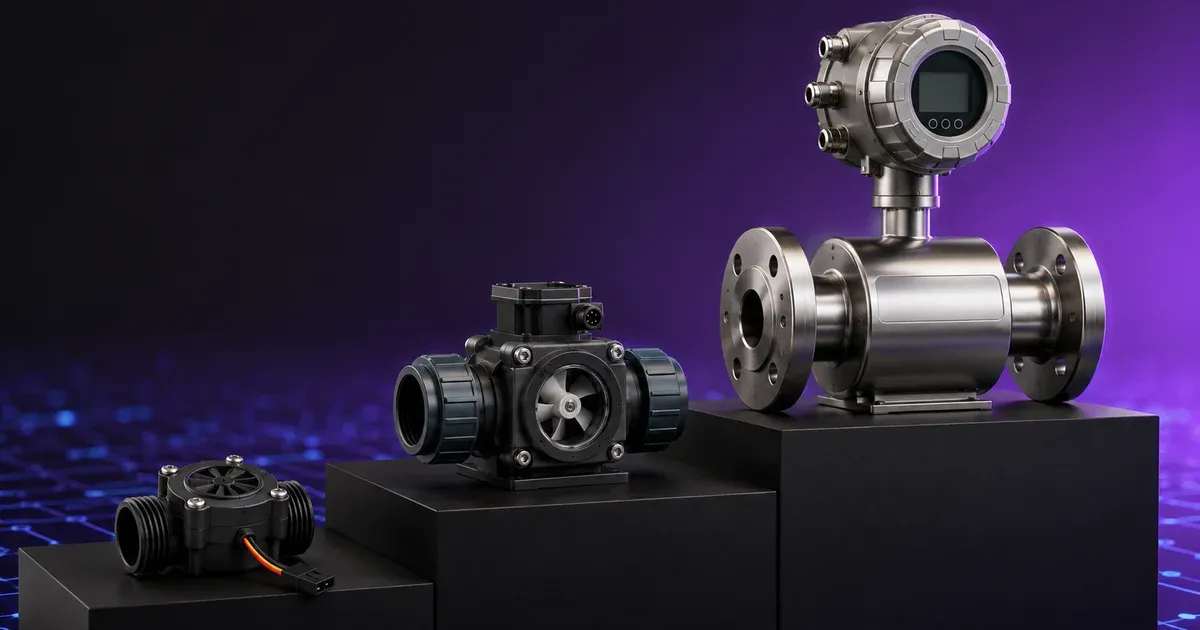
Water & Liquid Flow Sensors: From Turbine to Coriolis — The Complete Quality-Tier Buyer's Guide
By LoopString Team
Quick picks by tier. Hobby → a YF-S201 hall-effect turbine. Maker/Prosumer → a paddlewheel or better turbine with a 4-20 mA output. Commercial → an ultrasonic clamp-on (transit-time) or an electromagnetic magmeter. Hardened industrial / custody → a Coriolis mass-flow meter. Why each wins is below.
The thing that actually bites you: the accuracy cliff and the moving impeller
Flow is the measurement where the price–accuracy curve has a cliff, not a slope. A $10 turbine and a $400 ultrasonic meter aren't "a bit different" — they're ±10% versus ±1%, and most of that gap is mechanical. The cheap tiers all share one liability: a moving impeller in the flow path. It wears, it fouls with scale and biofilm, it jams on grit, and its calibration walks as the bearing ages. A turbine that's dead-on out of the box can be 8% off a year later in hard water, and nothing tells you — the pulses keep coming.
The second trap is installation, not the sensor. Almost every flow technology assumes a full pipe and a length of straight run before and after the meter (typically 10 diameters upstream, 5 down). Mount a meter right after an elbow, a valve, or a pump and the turbulent, swirling profile throws the reading off by more than the sensor's spec — people blame the meter for an install error. Turbines also care about viscosity; a sensor calibrated on water reads wrong on glycol or oil.
The third thing to decide up front is volumetric vs mass flow. Turbines, ultrasonic, and mag meters measure volume (L/min) — which changes with temperature and density. Coriolis measures mass (kg/min) directly, which is what you actually want for dosing, custody transfer, and any recipe by weight.
So the real question isn't "how many litres per minute?" — it's "how accurate do I truly need it, can I give it a full pipe and straight run, and do I need volume or mass?"
The decision axes
- Technology — mechanical turbine/paddlewheel (moving parts) → ultrasonic transit-time (non-invasive) → electromagnetic (no obstruction, conductive liquids) → Coriolis (mass).
- Accuracy — ±5–10% (hobby turbine) → ±1–2% (ultrasonic) → ±0.5% (mag) → ±0.1–0.5% (Coriolis).
- Wear & fouling — moving parts wear and clog; ultrasonic, mag, and Coriolis have no obstruction in the flow.
- Fluid compatibility — mag meters need an electrically conductive liquid; turbines hate grit; ultrasonic needs a fairly clean, bubble-free fluid.
- Invasiveness — inline (cut the pipe) vs clamp-on ultrasonic (strap to the outside, retrofit with zero downtime).
- Volumetric vs mass — most tiers are volumetric; only Coriolis is true mass (and gives density too).
- Interface — pulse output (count in software) → 4-20 mA → Modbus/HART.
Tier | Meter | Technology | Accuracy | Moving parts | Measures | Interface | Price (USD) | Best for |
|---|---|---|---|---|---|---|---|---|
Hobby | YF-S201 hall turbine | Hall turbine | ±5–10% | Yes (impeller) | Volumetric | Pulse (GPIO) | $5–15 | Hobby totalizing, clean water |
Prosumer | Paddlewheel / better turbine | Paddlewheel | ±2–5% | Yes | Volumetric | Pulse / 4-20 mA | $30–100 | Irrigation, rough dosing |
Commercial | Ultrasonic clamp-on (transit-time) | Ultrasonic | ±1–2% | None | Volumetric | 4-20 mA / Modbus | $200–800 | Non-invasive retrofit, no pressure drop |
Commercial | Electromagnetic (magmeter) | Electromagnetic | ±0.5% | None | Volumetric | 4-20 mA / Modbus | $300–1500 | Conductive / dirty liquids |
Industrial | Coriolis | Coriolis | ±0.1–0.5% | None | Mass (+density) | Modbus / HART | $2000–8000+ | Custody, precise dosing, any fluid |
Walking up the ladder
Hobby — YF-S201 hall-effect turbine ($5–15). An impeller spins a hall sensor and emits pulses you count on a GPIO; divide by the K-factor for litres. ±5–10%, fine for totalising garden water, a hobby pump, or "did the line flow?" It wears and fouls and is water-only. Stop here if rough volume on clean water is all you need.
Maker/Prosumer — paddlewheel / better turbine ($30–100). A sturdier impeller, sometimes with a 4-20 mA output and a real K-factor calibration, ±2–5%. Better materials and bearings push out the fouling interval. Stop here if you're metering irrigation zones or rough dosing and can tolerate a few percent.
Commercial — ultrasonic clamp-on or electromagnetic ($200–1500). Two no-moving-parts options. Ultrasonic transit-time straps to the outside of the pipe — zero downtime retrofit, no pressure drop, ±1–2% on a clean full pipe. Electromagnetic (magmeter) sits inline with an unobstructed bore, ±0.5%, and shrugs off dirty water and slurries — but only works on electrically conductive liquids (not pure water, oils, or gases). Stop here if you need accurate, low-maintenance flow on a real system.
Hardened industrial — Coriolis ($2000–8000+). The gold standard: measures mass flow directly (plus density and temperature), ±0.1–0.5%, on virtually any fluid, with no straight-run fussiness. Expensive and heavy, but the only honest answer for custody transfer, precise chemical dosing, or recipe-by-weight. You need this tier if money, safety, or a tight recipe rides on the number.
Interface & wiring notes (per tier)
- Hall turbine (pulse): one pulse line + pull-up to a GPIO; count edges and apply the K-factor. Debounce and don't exceed the Pi's input rate at high flow. Install with the arrow in the flow direction and a full pipe.
- Paddlewheel (pulse / 4-20 mA): same pulse handling, or read the 4-20 mA loop through a HAT. Give it the straight-run it specifies.
- Ultrasonic clamp-on: mount the transducers per the spacing table for your pipe OD and material, use couplant, and avoid mounting near bends; reads over 4-20 mA or Modbus. Bubbles and partially-full pipes break it.
- Magmeter: inline, must stay full and be properly grounded to the fluid (grounding rings) or the reading wanders; 4-20 mA / Modbus out.
- Coriolis: inline, heavy — support it mechanically; Modbus/HART for mass, density, and temperature in one instrument.
How LoopString reads every tier — in one dashboard
A Raspberry Pi running LoopString's Node-RED templates counts pulses from a $10 turbine and polls a $400 ultrasonic meter over Modbus into the same dashboard — same live flow rate, same totalised volume, same leak and no-flow alerts, same history. Prototype with a turbine, upgrade to a clamp-on or magmeter for the real install, and your dashboards and totals carry over. Wire your meter to a Pi and see it live at app.loopstring.io.
Useful next reads: the Raspberry Pi industrial monitoring guide, the Raspberry Pi automation guide, and the MQTT sensor dashboard overview.
Frequently asked questions
The cheap tiers all share one liability — a moving impeller in the flow path. It wears, fouls with scale and biofilm, and jams on grit, so its calibration walks as the bearing ages. A turbine that's dead-on out of the box can be 8% off a year later in hard water, and nothing warns you — the pulses keep coming. No-moving-parts technologies (ultrasonic, electromagnetic, Coriolis) avoid this entirely.
Related posts
- Dosing & Circulation Pumps: From Hobby Peristaltic to Industrial Metering Pumps — The Complete Quality-Tier Buyer's Guide
- Solenoid Valves: From Plastic Direct-Acting to Stainless Process Valves — The Complete Quality-Tier Buyer's Guide
- Fans & Blowers: From PWM PC Fans to Industrial EC Blowers — The Complete Quality-Tier Buyer's Guide