
Water Leak Detection: From Spot Sensors to Industrial Leak Panels — The Complete Quality-Tier Buyer's Guide
By LoopString Team
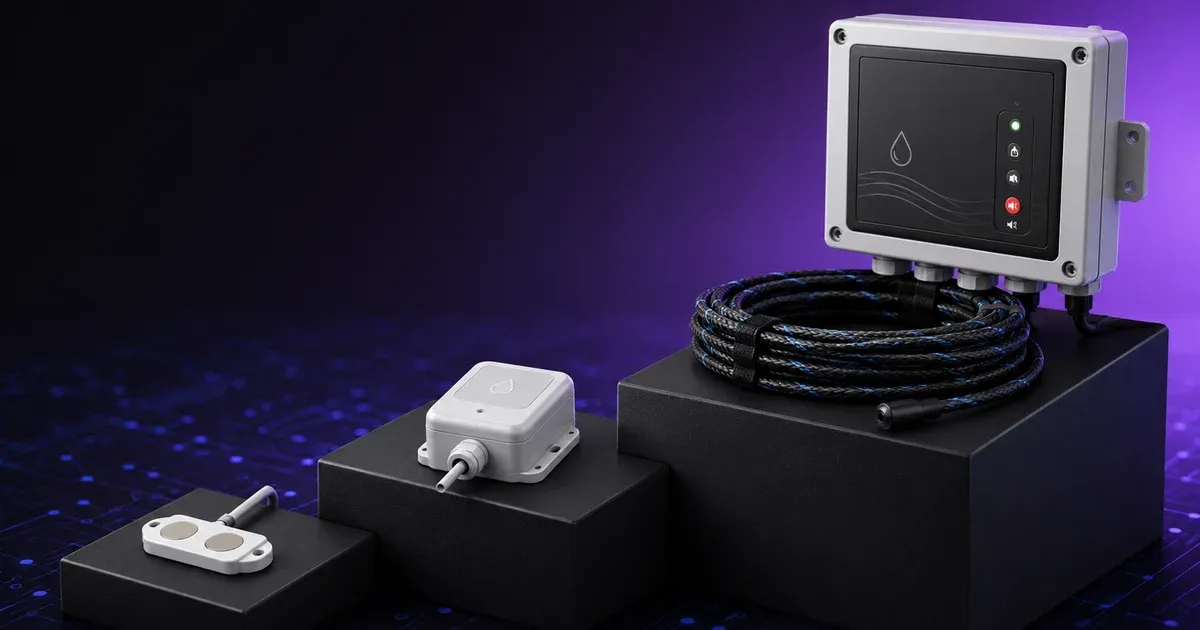
Quick picks by tier. Hobby → a resistive water-drop spot sensor. Maker/Prosumer → a capacitive or optical point leak sensor (works on deionized water and oils). Commercial → water-sensing rope/cable along a path. Hardened industrial / audited → an addressable leak-detection panel with distance-locating cable (TraceTek, RLE) on Modbus/BMS. Why each wins is below — but if you just need a name, start there.
The thing that actually bites you: a spot sensor only catches water that reaches the spot
Leak detection fails in a specific, expensive way: the sensor works perfectly and the leak still floods the room. A single spot sensor detects water at one point on the floor. Real leaks start at a fitting on the far wall, run under a raised floor, wick along a cable tray, and pool somewhere you didn't place a $5 board — and the first you hear of it is the ceiling below. Coverage, not sensitivity, is the thing that decides whether leak detection actually protects anything.
The second trap is the liquid itself. The cheapest spot sensors are resistive — two pads that conduct when water bridges them. They corrode (you're running current through wet metal), and they only detect conductive water. Deionized/RO water, condensate, and especially oils and refrigerants won't trip a resistive pad at all. Capacitive and optical point sensors, and the right sensing cable, detect those; resistive pads don't.
So the real question isn't "did water touch my sensor?" — it's "will I detect this leak before it does damage, will it trip on my actual liquid, and will I know where the leak is?"
The decision axes
- Coverage geometry — point (one spot) vs zone/path (sensing cable along the whole run). The single biggest driver of whether detection is useful.
- Locating — "a leak somewhere on this zone" vs distance-to-leak in metres (addressable cable). Matters when the run is long and access is hard.
- Liquid compatibility — resistive (conductive water only, corrodes) vs capacitive/optical/cable (DI water, condensate, oils, fuels, with liquid-specific cable variants).
- Latching & alarm logic — momentary detect vs latched alarm with manual reset; dry-contact relay vs digital output to a controller.
- Interface — GPIO digital → dry-contact relay → RS-485 Modbus / BMS integration.
- Environment — clean office floor vs raised data-center floor, mechanical room, or chemical bund; IP rating and chemical resistance of the cable jacket.
- Supervision — does the system know if the sensing cable is cut or disconnected (end-of-line supervision), so a failed sensor doesn't read as "no leak"?
Tier | Device | Method | Coverage | Locates leak? | Liquids detected | Supervised? | Interface | Price (USD) | Best for |
|---|---|---|---|---|---|---|---|---|---|
Hobby | Resistive water-drop spot pad | Resistive pads | Single point | No | Conductive water only (corrodes) | No | GPIO digital/analog | $3–8 | One low-stakes spot |
Prosumer | Capacitive / optical point sensor | Capacitive / optical | Single point | No | Water, DI, condensate, oils | No | GPIO / dry contact | $10–40 | A few discrete risk points |
Commercial | Water-sensing rope/cable | Sensing cable + controller | Whole path / zone | Zone only | Per cable chemistry | Some | Dry contact / RS-485 | $100–500+ | Server room, raised floor, pipe run |
Industrial | Addressable leak-locating panel (TraceTek, RLE) | Distance-locating cable | Zoned path | Yes — to the metre | Liquid-specific cable | Yes (end-of-line) | Modbus / BMS | $1000–5000+ | Data centers, clean rooms, audited |
Walking up the ladder
Hobby — resistive water-drop spot sensor ($3–8). Two interdigitated pads and a comparator. Perfect for a hobby project, a single washing-machine drip tray, or learning the idea. It corrodes over months of wet exposure and ignores non-conductive liquids. Stop here if you're protecting one well-defined low-stakes spot and you'll replace the pad periodically.
Maker/Prosumer — capacitive or optical point leak sensor ($10–40). A sealed point sensor that doesn't corrode and detects DI water, condensate, and oils that a resistive pad misses. Still single-point, but reliable and re-deployable. Stop here if you have a few discrete risk points (a water heater, an AC condensate pan, a single valve) and can put a sensor on each.
Commercial — water-sensing rope/cable ($100–500+ for cable + controller). Now you're covering a path: lay sensing cable around a server-room perimeter, under a raised floor, along a pipe run, or around a tank bund. Any water touching anywhere along the cable trips the zone. Choose the cable chemistry for your liquid (water vs hydrocarbon-sensing). Stop here if you're protecting a room, a floor void, or a pipe run rather than a single point.
Hardened industrial — addressable leak-locating panel ($1000–5000+). TraceTek, RLE and similar: distance-locating sensing cable that reports the leak's position to the metre, zoned panels, end-of-line supervision (it alarms if the cable is cut), latched alarms with relays, and Modbus/BMS integration with audit logging. You need this tier if you run a data center, a clean room, or a regulated facility where minutes and location matter and the leak system itself must be supervised.
Interface & wiring notes (per tier)
- Resistive/capacitive spot (GPIO): a simple digital high/low into a Pi GPIO (or analog for level-of-wetness). Mount it at the low point where water actually collects, not on the wall.
- Point sensor with dry contact: wire the relay contact into a GPIO with a pull-up; latch the alarm in software so a brief splash that dries doesn't clear itself silently.
- Sensing cable + controller: the controller does the detection; expose its alarm as a dry contact to the Pi, or read its RS-485/Modbus output for zone and — on locating systems — distance. Terminate and supervise the cable per the manufacturer's spec.
- Industrial panel (Modbus/BMS): read zones, distances, and supervision/fault state over Modbus; treat a cable fault as an actionable alarm, not silence.
A note on the failure that hides: the worst leak-detection failure is a sensor that has died or disconnected and therefore reports a permanent "dry" — you think you're covered and you're not. Cheap spot sensors have no self-supervision. If the asset is worth protecting, use a system with end-of-line supervision (or, on a Pi, periodically verify the sensor responds) so a missing sensor raises an alarm instead of staying quiet.
How LoopString reads every tier — in one dashboard
Here's the part that makes the whole ladder moot from a software standpoint: a Raspberry Pi running LoopString's Node-RED templates reads a $5 spot pad and an industrial leak-locating panel into the exact same dashboard — same live state, same instant leak alerts, same activity log. You can prototype with a point sensor and graduate to supervised sensing cable for production without touching your dashboards or alert routing. Pick the tier your assets actually need using the table above, wire it to a Pi, and get an alert the moment water appears at app.loopstring.io.
Useful next reads: the Raspberry Pi industrial monitoring guide, the Raspberry Pi automation guide, and the MQTT sensor dashboard overview.
Frequently asked questions
Almost always coverage: a spot sensor only detects water that physically reaches that one point, and real leaks pool somewhere else. Mount sensors at the actual low point, or use water-sensing rope/cable that detects water anywhere along a path. Also check the liquid — resistive pads ignore deionized water and oils.
Related posts
- Dosing & Circulation Pumps: From Hobby Peristaltic to Industrial Metering Pumps — The Complete Quality-Tier Buyer's Guide
- Solenoid Valves: From Plastic Direct-Acting to Stainless Process Valves — The Complete Quality-Tier Buyer's Guide
- Fans & Blowers: From PWM PC Fans to Industrial EC Blowers — The Complete Quality-Tier Buyer's Guide