
PPFD to DLI Calculator: Convert Light Intensity to Daily Light Integral (2026)
By LoopString
DLI = PPFD × photoperiod hours × 0.0036. A canopy reading of 600 µmol/m²/s under an 18-hour day = 600 × 18 × 0.0036 = 38.9 mol/m²/day. That is the whole conversion. Below is the formula in both directions, the PPFD and DLI targets to aim for at each growth stage, and a free PPFD↔DLI calculator that does the math and checks it against your crop.
What is DLI, and how is it different from PPFD?
PPFD (photosynthetic photon flux density) is intensity — how many photosynthetically useful photons land on one square metre every second, in µmol/m²/s. It is an instantaneous snapshot.
DLI (daily light integral) is dose — the total moles of those photons delivered to that square metre over a full day, in mol/m²/day. It is intensity multiplied by time.
Two rooms can read the same PPFD on the meter and deliver completely different DLI: 600 µmol/m²/s for 12 hours is 25.9 mol/m²/day; the same 600 for 18 hours is 38.9. The plant responds to the daily dose (DLI), so PPFD alone cannot tell you whether you are under- or over-lighting — you need the photoperiod too. That is the input most online DLI calculators leave out.
The PPFD to DLI formula
DLI (mol/m²/day) = PPFD (µmol/m²/s) × photoperiod (hours) × 3600 ÷ 1,000,000
= PPFD × hours × 0.00363600converts per-second to per-hour.÷ 1,000,000converts micromoles (µmol) to moles (mol).- Combined, the constant is 0.0036.
To go the other way — you know your target DLI and photoperiod, and want the PPFD to dial in:
Required PPFD = target DLI ÷ (photoperiod hours × 0.0036)The calculator runs both directions and flags the result against the growth stage you pick.
PPFD targets by growth stage
Aim your intensity here, then use the photoperiod to land the daily dose in the next table.
[Table content]
PPFD ranges are practitioner consensus corroborated across multiple horticulture sources.
DLI targets by crop
Commonly-cited DLI ranges; confirm against your cultivar and light maps. Practitioner consensus, not a precision spec.
[Table content]
Worked examples
- Leafy greens, 16 h photoperiod, want DLI ≈ 14: required PPFD = 14 ÷ (16 × 0.0036) = ~243 µmol/m²/s — squarely in the 200–400 veg band.
- Cannabis flower, 12 h photoperiod, canopy reads 800 PPFD: DLI = 800 × 12 × 0.0036 = 34.6 mol/m²/day — bottom of the flower range; raise intensity or you leave yield on the table.
- Seedlings, 18 h, want DLI ≈ 10: required PPFD = 10 ÷ (18 × 0.0036) = ~154 µmol/m²/s — gentle, correct for clones.
Why a meter reading at one spot isn't your DLI
PPFD varies enormously across a canopy — center-to-edge falloff of 30–50% is normal under a single fixture. A single handheld reading at the brightest spot overstates the average DLI the crop actually receives. To trust your DLI you need either a light map (many readings averaged) or a fixed PAR/quantum sensor logging continuously — which also catches driver dimming, photoperiod drift, and fixture aging that a one-time reading never will.
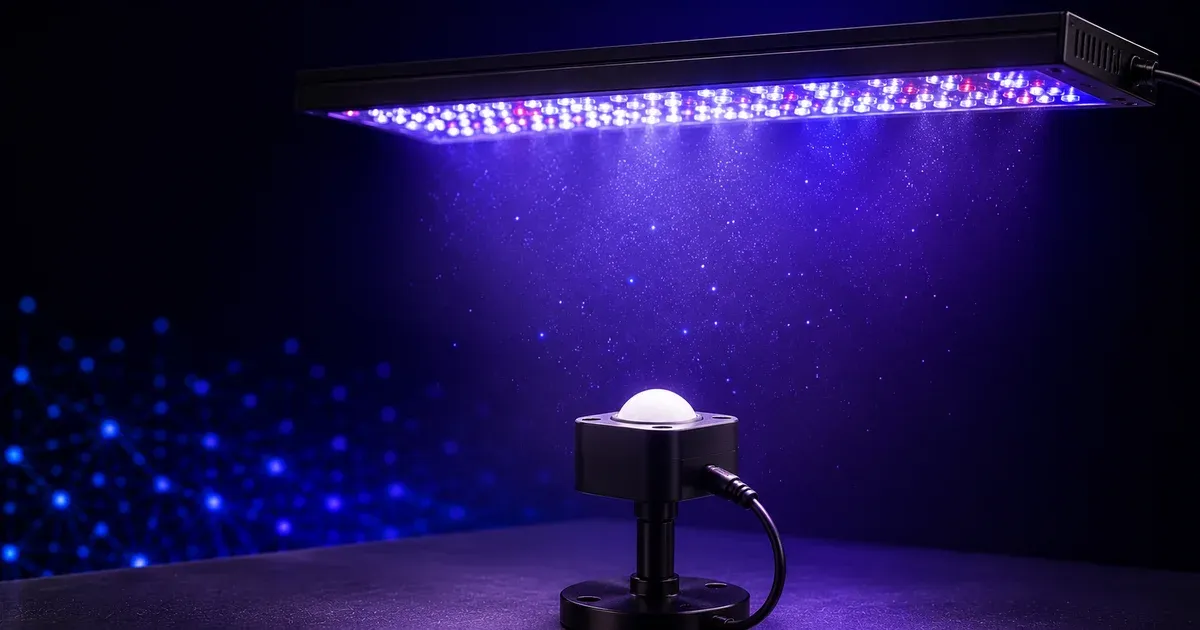
Stop guessing your DLI. LoopString reads a fixed PAR/quantum sensor on a Raspberry Pi, logs PPFD continuously, and holds your photoperiod on a schedule — so your daily light dose is measured, not estimated.
Frequently asked questions
Use DLI = PPFD × photoperiod hours × 0.0036. For example, a canopy reading of 600 µmol/m²/s under an 18-hour day is 600 × 18 × 0.0036 = 38.9 mol/m²/day. The 0.0036 constant comes from 3600 (per-second to per-hour) divided by 1,000,000 (µmol to mol).