
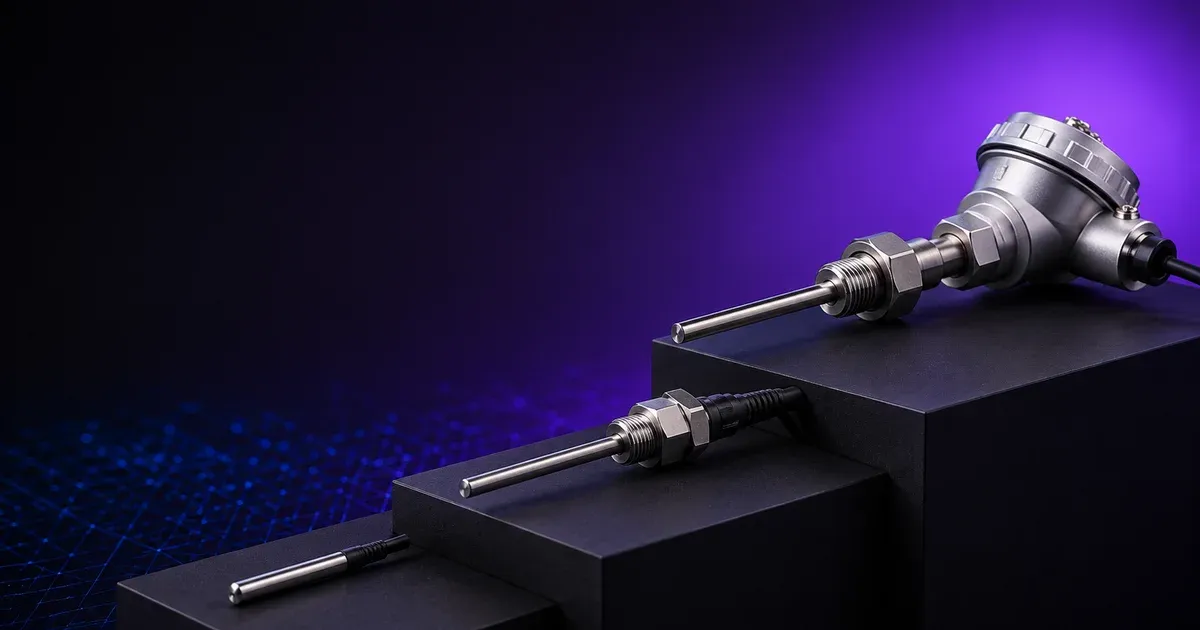
Temperature Probes: From DS18B20 to Thermocouples — The Complete Quality-Tier Buyer's Guide
By LoopString Team
Quick picks by tier. Hobby → DS18B20 (1-wire, waterproof) or an NTC thermistor for fast/cheap. Maker/Prosumer → a PT100/PT1000 RTD on a MAX31865. Commercial → an industrial RTD probe in a thermowell with a 4-20 mA transmitter. Hardened industrial / extreme heat → a Type K/N/R/S thermocouple + transmitter. Why each wins is below.
This guide is the companion to our temperature & humidity sensor guide — that one covers ambient air and relative humidity; this one covers contact temperature probes for liquids, surfaces, immersion, and extreme ranges from cryogenic to furnace, where a board sensor can't go.
The thing that actually bites you: range, wiring, and the cold junction
Temperature looks like the easy measurement — every part claims a tenth of a degree — and then three things quietly ruin the reading.
First, range dictates technology, not preference. A DS18B20 is wonderful up to +125 °C and useless in a kiln. A thermocouple reads to +1700 °C and is hopeless at resolving a fridge to 0.1 °C. You don't pick the best sensor; you pick the one whose range brackets your job, then optimise accuracy within it.
Second, wiring error swamps sensor accuracy. A 2-wire RTD adds the resistance of its own lead wires to the measurement — a few ohms of cable can read as several degrees of error. RTDs need 3- or 4-wire connections to cancel it. Thermistors and RTDs also self-heat: the excitation current you push through them to measure resistance warms them up, so a sensor in still air or a small thermal mass reads high.
Third, and the classic: thermocouples need cold-junction compensation (CJC). A thermocouple only measures the difference between the hot tip and the connector where it meets copper. Get the cold-junction temperature wrong — or run plain copper wire instead of matching thermocouple extension wire — and the whole reading shifts. Polarity matters too; a reversed thermocouple reads backwards.
So the real question isn't "how accurate is the sensor?" — it's "does its range bracket my job, and have I wired it so the cable and cold junction aren't lying to me?"
The decision axes
- Range — the first filter: −55…+125 °C (DS18B20) → −40…+150 °C (thermistor) → −200…+600 °C (RTD) → −200…+1700 °C (thermocouple).
- Accuracy & stability — RTDs are the most accurate and stable mid-range; thermocouples trade accuracy for reach; thermistors are precise in a narrow band.
- Linearity — DS18B20 and RTDs are near-linear; thermistors are steeply nonlinear and need Steinhart-Hart correction.
- Wiring — 1-wire digital → analog (ADC) → 3/4-wire RTD (MAX31865) → thermocouple amp with CJC (MAX31855/31856) → 4-20 mA transmitter.
- Response time & thermal mass — bare thermistors are fast; sheathed probes and thermowells are slow but rugged.
- Enclosure — bare bead → waterproof sheath → thermowell (lets you pull the probe without breaching the process).
- Traceable calibration — the audit requirement for cold-chain, pharma, and process safety.
Tier | Probe | Element | Range | Accuracy | Linearity | Interface | Price (USD) | Best for |
|---|---|---|---|---|---|---|---|---|
Hobby | DS18B20 | 1-Wire digital | −55…+125 °C | ±0.5 °C | near-linear | 1-Wire | $2–5 | Waterproof, multi-drop, convenient |
Hobby | NTC thermistor 10k | Thermistor | −40…+150 °C | ±0.1–1 °C | nonlinear (Steinhart-Hart) | Analog (ADC) | $1–5 | Fast, cheap, narrow band |
Prosumer | PT100 / PT1000 RTD + MAX31865 | Platinum RTD | −200…+600 °C | ±0.15–0.5 °C | linear | SPI (3/4-wire) | $10–50 | Accurate, stable, drift-free |
Commercial | Industrial RTD probe + 4-20 mA transmitter | Sheathed RTD, thermowell | −200…+600 °C | ±0.1–0.3 °C | linear | 4-20 mA | $60–300 | Process, harsh, long runs |
Industrial | Thermocouple Type K/N/R/S + transmitter | Thermocouple (CJC) | −200…+1700 °C | ±1–2 °C / 0.75% | nonlinear | 4-20 mA / SPI | $20–500+ | Furnaces, kilns, extreme heat |
Walking up the ladder
Hobby — DS18B20 ($2–5). A 1-wire digital probe, ±0.5 °C from −10 to +85 °C, available in a waterproof stainless sheath, and — the killer feature — you can multi-drop dozens on a single GPIO because each has a unique address. Perfect for fridges, tanks, brew kettles, and soil/water temperature. Stop here if your range fits within −55…+125 °C and ±0.5 °C is fine.
Hobby+ — NTC thermistor ($1–5). Cheaper, faster, and more sensitive than a DS18B20 in a narrow band, but steeply nonlinear (needs a Steinhart-Hart curve) and analog (needs an ADC). Great where response speed matters — a hotend, a fast-moving liquid. Stop here if you need speed and low cost over absolute accuracy.
Maker/Prosumer — PT100 / PT1000 RTD + MAX31865 ($10–50). This is the accuracy-and-stability tier: platinum RTDs are linear, drift-free, and accurate to ±0.15–0.5 °C across −200…+600 °C. The MAX31865 handles 3/4-wire sensing so lead resistance stops mattering. Stop here if you need real precision in the −200…+600 °C band and care about long-term stability.
Commercial — industrial RTD probe + 4-20 mA transmitter ($60–300). A sheathed RTD in a thermowell with a head-mounted transmitter outputting 4-20 mA you can run hundreds of metres. The thermowell lets you replace the probe without opening the process — essential in food, pharma, and pressurised systems. Stop here if you have a real process line, wash-down, or long cable runs.
Hardened industrial — thermocouple Type K/N/R/S + transmitter ($20–500+). When the range exceeds what RTDs survive — furnaces, kilns, exhaust, molten processes — thermocouples reach +1700 °C (platinum R/S/B) and tolerate brutal environments. You trade accuracy (±1–2 °C or 0.75%) for reach, and you pair them with a transmitter that does CJC and can ship traceable calibration. You need this tier if your process runs hot enough to destroy an RTD, or an auditor needs a cert.
Interface & wiring notes (per tier)
- DS18B20 (1-wire): one data line + 4.7 kΩ pull-up; parasitic-power mode works but external 3.3 V is more reliable on long buses. Each probe is individually addressed for multi-drop.
- Thermistor (analog): read through an ADC in a voltage divider; keep excitation current low to limit self-heating, and linearise with Steinhart-Hart in software.
- RTD (3/4-wire, MAX31865): always use 3- or 4-wire — 2-wire adds lead resistance as error. Match the chip's reference resistor to PT100 vs PT1000.
- Thermocouple (MAX31855/31856 + CJC): use matching thermocouple extension wire, never copper, all the way to the cold junction; observe polarity; pick the type for your range (K general, N harsh/high-temp, T cryogenic, R/S/B extreme).
- 4-20 mA transmitters: loop-powered, immune to distance; head-mount on the probe so only a clean current loop runs back to the Pi's 4-20 mA HAT.
How LoopString reads every tier — in one dashboard
A Raspberry Pi running LoopString's Node-RED templates reads a $3 DS18B20 over 1-wire and a $300 thermowell RTD transmitter over 4-20 mA into the same dashboard — same live trend, same threshold and rate-of-change alerts, same compliance log for cold-chain and process records. Prototype on a DS18B20, move to an RTD or thermocouple loop for production, and your dashboards and history don't change. Wire your probe to a Pi and see it live at app.loopstring.io.
Useful next reads: the PID temperature control guide, the Raspberry Pi industrial monitoring guide, and the Raspberry Pi automation guide.
Frequently asked questions
Two wiring traps cause it. A 2-wire RTD adds the resistance of its own lead wires to the measurement — a few ohms of cable can read as several degrees of error — which is why RTDs need 3- or 4-wire connections (e.g. via a MAX31865) to cancel it. Both RTDs and thermistors also self-heat: the excitation current you push through them to measure resistance warms them up, so a probe in still air or a small thermal mass reads high. Keep excitation current low.
Related posts
- Dosing & Circulation Pumps: From Hobby Peristaltic to Industrial Metering Pumps — The Complete Quality-Tier Buyer's Guide
- Solenoid Valves: From Plastic Direct-Acting to Stainless Process Valves — The Complete Quality-Tier Buyer's Guide
- Fans & Blowers: From PWM PC Fans to Industrial EC Blowers — The Complete Quality-Tier Buyer's Guide